They All Love Jack - Busting the Ripper by Bruce Robinson
Fourth Estate 2015


Not why did Maybrick do it, but rather: why does Robinson believe it?
I've read enough Jack the Ripper books in my time for me not to expect the cut-and-dried proof of culpability that is so often promised by overoptimistic subtitles along the lines of The Final Chapter, The Final Solution or Case Closed. I'm just looking for a reasonable case to be made, which might lead others to investigate further, perhaps to bolster the case, perhaps to refute it.
To that end, I find a good starting point is to discover why the authors first came up with their initial suspect - why they believe they've finally cracked it. In the case of Paul H. Feldman and others who suspect James Maybrick it's pretty obvious: the discovery of a diary which, if genuine, inescapably suggests James Maybrick was the Ripper. In the case of Patricia Cornwell suspecting Walter Sickert it was because ... er ... someone mentioned to her that he was already a suspect.
 |
| Suspects: Walter Sickert and James Maybrick |
And so something must have led Bruce Robinson to suspect Michael Maybrick, yet he never mentions what it was. One can only assume that the reason is the obvious one: that Michael's brother James was already a suspect, but since the initial suspicion is such a large part of why an author believes in their case, it really should be shared with the reader. Not to do so seems to be an attempt to portray a false aura of impartiality. Cornwell attempts much the same trick, leaving unmentioned virtually any of the books that had gone before, both those that claim Sickert was the Ripper and those that refute it. Robinson does discuss the diary, but never makes clear if it, or anything else, was his starting point.
But it's not where you start it's where you finish, and Robinson's starting point doesn't much matter if in the end the case against Michael Maybrick is clear. Not iron-clad; simply clear.
The problem is that in all of the 800 plus pages, Robinson doesn't even attempt to make a case against Maybrick. The best I can pull together is this:
1) The Ripper was a Freemason. Michael Maybrick was a Freemason.
Personally, I think there is a case that the Ripper might have been a Mason. It's not strong and there's nothing much here that's not been derived from previous works on the subject, but it's possible. Robinson certainly produces clear evidence that Maybrick was a Mason. But the problem is hardly worth pointing out. Robinson himself spends pages bewailing the fact that British society was riddled with Freemasons. The Ripper connection could point to any one of them. Again the question arises: why Michael? Again there is no answer.
2) Michael Maybrick matches one of the few eyewitness descriptions.
Robinson spends a lot of time discussing how the police either ignored or suppressed the evidence of Matthew Packer, a fruiterer who claimed to have seen a man accompanying Elizabeth Stride shortly before her murder. Given Robinson's belief that the police - particularity Commissioner Sir Charles Warren - were trying to cover up the the true culprit, Packer's testimony takes on additional significance. Sketches were published based on Packer's description, and certainly one of them looks a little bit like Maybrick.
 |
| Sketches from the Daily Telegraph 6/10/1888 |
 |
| Michael Maybrick |
Evidence at last?
Clearly not - and for the same reason that the masonic link is not evidence: thousands of people could roughly match that sketch. Indeed, a vagrant called John Langan was arrested in Boulogne on the basis of the sketch, and later found to be innocent. Or was it Joe Barnett, Mary Kelly's lover, and for some a Ripper suspect?
 |
| Joe Barnett |
The sketch is so rough it could be any one of 10,0000 men. But the problem for Robinson is more profound than this.
Packer did not just provide a sketch. He watched Stride and the man standing side-by-side for almost half an hour and described the latter as between 30 and 35 years old (younger in some versions of his statement) and of medium height (5'7"). Michael Maybrick was 6'1" and 47 years old at the time of the murders. Packer may or may not be a reliable witness, but whatever testimony he offers, it stands against the idea that Maybrick was the Ripper.
3) The Whitechapel murders cluster around Toynbee Hall.
They certainly do. Toynbee Hall was (and is) a charitable welfare centre at the heart of the East End. At the time of the murders it was often used as a venue for concerts and other entertainments for the local people. Michael Maybrick - by profession a singer and composer - might well have gone there to perform. Indeed Robinson offers much evidence to demonstrate that several of Maybrick's friends and colleagues did visit the hall. And yet he offers no direct evidence that Maybrick himself was ever there. That's not to say that Maybrick was never at Toynbee Hall, but whatever evidence there is would surely point to one of those we know was there - several of whom were Freemasons - than to someone who may or may not have been. And even then, Tonybee Hall is far from being the only building in Whitechapel which the the Ripper might have used as his lair.
4) All the Ripper letters were genuinely written by the murderer AND Michael Maybrick wrote all the Ripper letters.
Clearly if both these propositions are true then it's an open and shut case, but they're both patent nonsense. The Ripper letters came from all over the country - indeed all over the world - and were written in a variety of hands. Most Ripperologists (Robinson doesn't much like Ripperologists, mostly because of their failure to spot what is so obvious to him) regard few or none of them as genuine. That's not to say that some or many of them may be genuine, but you really have to make a case for each one of them - not take on a blanket assumption. Hundreds were received and Robinson treats them all as being sent by the murderer - even those which don't even make that claim themselves and are merely letters about the murders.
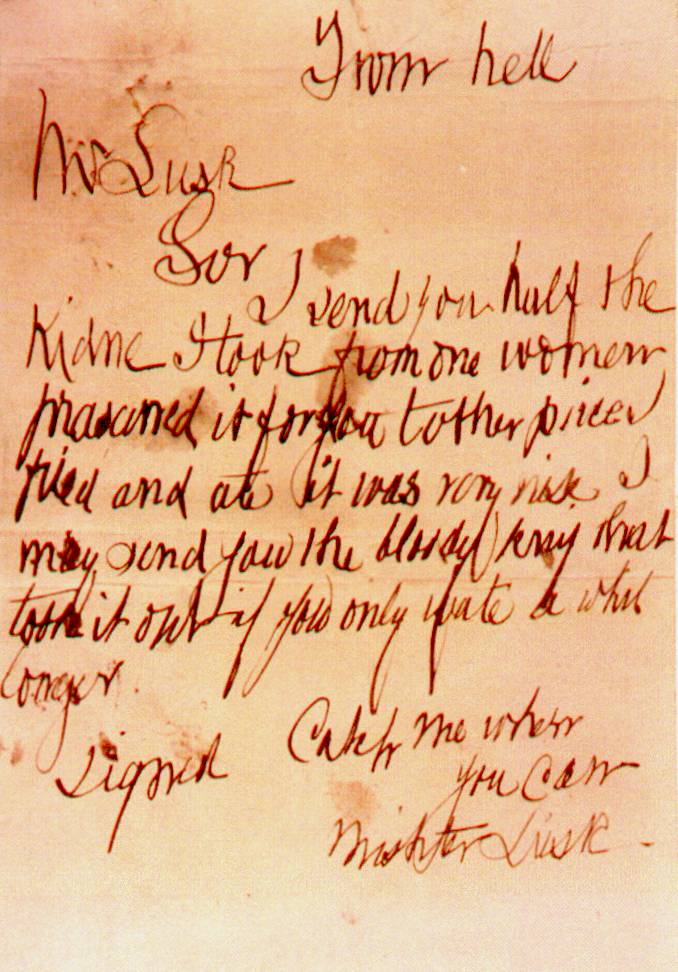 |
| The 'From Hell' Letter |
The evidence that Maybrick wrote the letters is insulting to the reader. The letters came from all parts of the country and Maybrick, in visiting concert venues, travelled across the country. But for all that, Robinson offers only one example of an occasion when Maybrick was in the right city at about the right time to coincide with a letter's posting. This should be a rich source of evidence. Maybrick's concerts were widely advertised in newspapers. One might expect a clear analysis cross-referencing letters with concert venues, but none is given. Whether Robinson shunned this kind of forensic approach, or pursued it and decided not to include the results, I don't know.
Robinson explains the letters from the USA by pointing out that someone could board a ship in a British port (say Liverpool), post a letter in the on-board mailbox and then leave the ship. The letter itself would travel to the States, be franked there and then would come back on the next boat, apparently sent from abroad. It may well be that this could be done, but there are still a few dots to join up in demonstrating that it was done, that it was done by Michael Maybrick (rather than anyone else who happened to be in Liverpool sometimes) and that the author was the Ripper.
As to the handwriting, well as Robinson points out:
Michael Maybrick himself had many styles of handwriting, and used many different pens - his table was 'littered with quill pens', noted the New Era article.
There's no direct evidence to support the idea of multiple handwriting styles - but it's evidently a well-known characteristic of people who have several pens.
Even if you ignore the nonsense of travelling from one side of the country to the other in a single day, and having multiple handwriting styles, the fundamental problem remains. Like all evidence based on the letters, it's a case of the Texas Sharpshooter Fallacy. With hundreds of letters to choose from, you're bound to be able to find clues suggesting almost anybody.
-
And that's really it for the case against Michael Maybrick. He was a Freemason who looked a bit like one sketch of a possible suspect. The real reason for accusing him is that he's the brother of James Maybrick - who's a much stronger, though still unlikely candidate. The trouble is, James Maybrick has already been 'done'.
Robinson spends the last section of the book looking at the death of James Maybrick and subsequent trial of his widow, Florence, for her husband's murder. His belief is that it was Michael who in fact killed James and then contrived to frame Florence. In comparison with his charge that Michael was the Ripper, Robinson offers better (i.e. some) evidence, but what's new is not good and what's good is not new. The fact that Florence was innocent has been known widely asserted since the time of the trial and has been covered by many. Robinson provides some reasons to believe that Michael was responsible, but it's not close to convincing. And anyway, the book is supposed to be about demonstrating that Michael Maybrick was Jack the Ripper, not that he killed his brother.

There are a few positives from the book. Robinson makes a clear case for the incompetence of the Metropolitan Police in investigating the crimes, and conveys it with a evident passion, as he does his description of the inequalities of Victorian London. But this is no substitute for logic and accuracy. He bases most of his Freemasonry theory on work already done by Stephen Knight (in Jack the Ripper - The Final Solution) and others, but then misrepresents Knight's position on many important details, claiming that Knight said:
- The Duke of Clarence1 was the Ripper. No, Knight said the Ripper murders were done by others to cover up Clarence's morganatic marriage.
- Annie Crook, Clarence's supposed wife, was a prostitute. No, Knight says she worked in a sweet shop. (I may be being unfair here. Robinson actually describes Crook as a 'whore' and it's hard to know whether this is meant to be taken literally or is just another of the abusive epithets he scatters through the book.)
- Martha Tabram was a Ripper victim. No, Knight sticks to the canonical five and regards Tabram as being the victim of a different killer.
- Catherine Eddowes was one of the women who tried to blackmail the establishment over Clarence. No, Knight claims Eddowes had nothing to do with the blackmail and was killed because she was mistaken for Mary Kelly.
All these may be small errors, but they reflect a sloppy attitude to research. If I can spot all these mistakes in the two paragraphs Robinson writes on a subject with which I am familiar, why should I trust his reporting on other matters with which I am less so?
-
The figure of Clarence and Robinson's habit of flinging abuse at the characters he describes leads on to one of the book's more unsettling, if peripheral aspects. Robinson describes the Duke of Clarence's probable involvement in the Cleveland Street Scandal. Again there's nothing new here - a male brothel on London's Cleveland Street was raided and there was evidence that Clarence had been a client. Homosexuality was illegal at the time, but moreover many of the boys working there were under-age even by today's laws.
Thus when Robinson describes Clarence as an 'effete little useless pederast' it's possibly true and given the nature of the crime it's difficult to object completely to the level of invective. It's disturbing, however, when his name-calling takes a more generally homophobic turn. Terms such as 'nancy' seem to say more about the writer than the individual described. In discussing Michael Maybrick's motive (that he was gay and therefore - obviously - hated women) Robinson gives us:
I don’t actually know if Maybrick was homosexual, but predicated on that infallible adage, 'If it walks like a duck, etc', he was probably a bit of a ducky.
Aside from the fact that Robinson doesn't 'actually know' very much at all about the case, one can't help feeling that those encounters with Uncle Monty, as told in Withnail and I, left a little bit more of a scar on the memory than we might have imagined.
 |
| Richard Griffiths as Uncle Monty |
Admittedly it's somewhat refreshing to read a book on Jack the Ripper that displays an angry contempt for the failures of Victorian jurisprudence rather than mere historical disinterest, but it should cut both ways. Robinson is at perhaps his most passionate when describing two flagrant miscarriages of justice: Florence Maybrick's conviction for the murder of her husband and the case of William Barrett, tried (though acquitted) for the murder of 8-year-old Johnnie Gill in Bradford in December 1888 (where Robinson can be particularly sure of Barrett's innocence since he knows that the Ripper/Maybrick, in a surprising change of modus operandi, was in fact the killer).
Both Florence Maybrick and William Barrett were almost certainly innocent - there was no more than a hint of a prima facie case against them. Robinson is right to berate those who tried to condemn them.
Perhaps though, in the case of Michael Maybrick where Robinson provides not even that much in the way of evidence, he might consider the plank in his own eye first.
Notes:
1. Prince Albert Victor didn't actually receive the title Duke of Clarence until after the time of the murders, but this is generally how he is referred to.


