Showing posts with label Review. Show all posts

Saturday, 8 October 2016

Sweeney was Smooth – Sweeney was Subtle

Review: Sweeney Todd: The Demon Barber of Fleet Street.
88 London Road, Brighton, 4 – 29 October 2016.


Aficionados of this weblog may note a couple of disturbing trends: the only books I seem to review are about Jack the Ripper and the only shows are productions of Sweeney Todd.

Perhaps this reflects something of my macabre predilections, but the basic reason is that I only like to review subjects that I really know something about, and I’ve seen sufficient productions of Sweeney Todd to make even professional stick-shakers back away in fear.

There have been big productions of Sweeney Todd and small ones, and director Conor Baum’s interpretation is definitely at the small end of the scale, with just eight actors covering all the roles and the work of the chorus. Productions of this size can flounder, but Baum exploits the limitations entirely to his advantage. The small, claustrophobic space at 88 London Road is perfect for the gothic atmosphere and is used flawlessly to convey the variety of scenes visited as the story progresses, whilst maintaining its centre of Todd’s tonsorial parlour glowering above Mrs Lovett’s pie shop down below.

The mechanics of that set are vital to any production of Sweeney. It needs to work for Pirelli’s semiconscious body in the trunk, his hand reaching out and grasping; for delivering Todd’s victims down from his chair; for those victims to arrive in the cellar below. And on top of that we need a convincing bake-oven to boot. For any production that does not have an infinite budget, these can be a sticking point. Some ignore the problems; others bodge the solutions. Here, Cath Prenton’s set combined with some clever direction worked excellently, showing those things that could be achieved on stage and smoothly allowing our imaginations to fill in what couldn’t.

The cast did astonishing work in covering their own main roles plus countless minor parts. All sang wonderfully, though some seemed to get into the skin of their character a little better when singing than when speaking. Clear exceptions to that would be Alice Redmond (Mrs Lovett), Samuel Clifford (Beadle Bamford) and Alistair Higgins (Tobias), all of whom gave entirely convincing performances throughout. Indeed, Higgins was one of the best Tobys I’ve seen, avoiding the pitfall of being too sweet and just a bit too ‘musical theatre’. Anthony is always a difficult role to cast, and while Dale Adams sang it wonderfully, his presence on stage was more than a little too graceful to fit in with the grittiness of the rest of the cast. A bold but effective decision was made to cast Rebecca Bowden as both the beggar woman and Adolfo Pirelli. Pirelli requires a high tenor voice which is sometimes rewritten or simply fluffed. It was wonderful to hear Bowden hitting those notes clearly and beautifully – a full octave higher than the score. 

Alistair Higgins
Like the cast, the orchestra was similarly pared down to just three: cello, keyboard and piano, from which musical director Ellen Campbell conducted. At times this led, understandably, to a few gaps in comparison with the Broadway recording with which many in the audience will be familiar, but at others it was fascinating to hear individual musical lines that are often lost in the hubbub. The same was true of the choral numbers performed by just eight voices. Here nothing was lost (except perhaps the occasional oomph of a choir of sixty emitting a forte fortissimo ‘Swing your razor wide, Sweeney!’) and everything was gained. Each vocal line was clear and could be appreciated either on its own or as part of the overall harmony. As anyone who has sung them will know, these choral numbers are fiendishly tricky, and without exception the cast performed them brilliantly, in many cases with only a single voice on each line. As far as I could tell the score was complete with the exception of the tooth pulling (which is commonly cut) and The Tower of Bray, which I have to say I’d have liked to hear.

Alice Redmond
For any show as well-known as Sweeney cast and director must be working constantly to keep things interesting for an audience who for the most part know exactly what is coming next. Here there were always subtle and interesting things going on, such as the changing newspaper headlines for each scene and indeed the whole setting of the story as being some kind of newspaper report. And it’s always a treat to hear a new joke in a familiar text, in this case from Alice Redmond – prima inter pares of a hugely talented cast – during By the Sea with ‘I’ll be there slipping off your [pause] slippers.’ It may have been done before, but it was new to me.

I’d always recommend to someone who’s never seen Sweeney to go and see almost any production, including this one. The stronger recommendation is to those who have seen the show before – and Brighton’s full of them. This production really will add something to your appreciation of the show. And the good thing is it runs till the end of the month.


Links

88 London Road's website.
My review of English National Opera's 2015 production of Sweeney Todd.

Saturday, 21 November 2015

Review: They All Love Jack


They All Love Jack - Busting the Ripper by Bruce Robinson
Fourth Estate 2015


They All Love Jack
Bruce Robinson - best known as the writer and director of Withnail and I - believes that Michael Maybrick was Jack the Ripper. The question is: why?

Not why did Maybrick do it, but rather: why does Robinson believe it?

I've read enough Jack the Ripper books in my time for me not to expect the cut-and-dried proof of culpability that is so often promised by overoptimistic subtitles along the lines of The Final Chapter, The Final Solution or Case Closed. I'm just looking for a reasonable case to be made, which might lead others to investigate further, perhaps to bolster the case, perhaps to refute it.

To that end, I find a good starting point is to discover why the authors first came up with their initial suspect - why they believe they've finally cracked it. In the case of Paul H. Feldman and others who suspect James Maybrick it's pretty obvious: the discovery of a diary which, if genuine, inescapably suggests James Maybrick was the Ripper. In the case of Patricia Cornwell suspecting Walter Sickert it was because ... er ... someone mentioned to her that he was already a suspect.

Walter Sickert and James Maybrick
Suspects: Walter Sickert and James Maybrick

And so something must have led Bruce Robinson to suspect Michael Maybrick, yet he never mentions what it was. One can only assume that the reason is the obvious one: that Michael's brother James was already a suspect, but since the initial suspicion is such a large part of why an author believes in their case, it really should be shared with the reader. Not to do so seems to be an attempt to portray a false aura of impartiality. Cornwell attempts much the same trick, leaving unmentioned virtually any of the books that had gone before, both those that claim Sickert was the Ripper and those that refute it. Robinson does discuss the diary, but never makes clear if it, or anything else, was his starting point.

But it's not where you start it's where you finish, and Robinson's starting point doesn't much matter if in the end the case against Michael Maybrick is clear. Not iron-clad; simply clear.

The problem is that in all of the 800 plus pages, Robinson doesn't even attempt to make a case against Maybrick. The best I can pull together is this:

1) The Ripper was a Freemason. Michael Maybrick was a Freemason.

Personally, I think there is a case that the Ripper might have been a Mason. It's not strong and there's nothing much here that's not been derived from previous works on the subject, but it's possible. Robinson certainly produces clear evidence that Maybrick was a Mason. But the problem is hardly worth pointing out. Robinson himself spends pages bewailing the fact that British society was riddled with Freemasons. The Ripper connection could point to any one of them. Again the question arises: why Michael? Again there is no answer.

2) Michael Maybrick matches one of the few eyewitness descriptions.

Robinson spends a lot of time discussing how the police either ignored or suppressed the evidence of Matthew Packer, a fruiterer who claimed to have seen a man accompanying Elizabeth Stride shortly before her murder. Given Robinson's belief that the police - particularity Commissioner Sir Charles Warren - were trying to cover up the the true culprit, Packer's testimony takes on additional significance. Sketches were published based on Packer's description, and certainly one of them looks a little bit like Maybrick.

Packer's Suspect
Sketches from the Daily Telegraph 6/10/1888

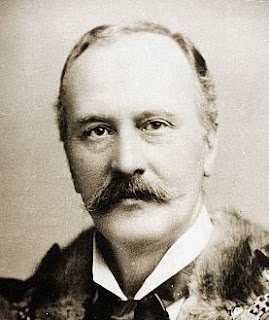
Michael Maybrick
Michael Maybrick

Evidence at last?

Clearly not - and for the same reason that the masonic link is not evidence: thousands of people could roughly match that sketch. Indeed, a vagrant called John Langan was arrested in Boulogne on the basis of the sketch, and later found to be innocent. Or was it Joe Barnett, Mary Kelly's lover, and for some a Ripper suspect?

Joe Barnett
Joe Barnett

The sketch is so rough it could be any one of 10,0000 men. But the problem for Robinson is more profound than this.

Packer did not just provide a sketch. He watched Stride and the man standing side-by-side for almost half an hour and described the latter as between 30 and 35 years old (younger in some versions of his statement) and of medium height (5'7"). Michael Maybrick was 6'1" and 47 years old at the time of the murders. Packer may or may not be a reliable witness, but whatever testimony he offers, it stands against the idea that Maybrick was the Ripper.

3) The Whitechapel murders cluster around Toynbee Hall.

They certainly do. Toynbee Hall was (and is) a charitable welfare centre at the heart of the East End. At the time of the murders it was often used as a venue for concerts and other entertainments for the local people. Michael Maybrick - by profession a singer and composer - might well have gone there to perform. Indeed Robinson offers much evidence to demonstrate that several of Maybrick's friends and colleagues did visit the hall. And yet he offers no direct evidence that Maybrick himself was ever there. That's not to say that Maybrick was never at Toynbee Hall, but whatever evidence there is would surely point to one of those we know was there - several of whom were Freemasons - than to someone who may or may not have been. And even then, Tonybee Hall is far from being the only building in Whitechapel which the the Ripper might have used as his lair.

4) All the Ripper letters were genuinely written by the murderer AND Michael Maybrick wrote all the Ripper letters.

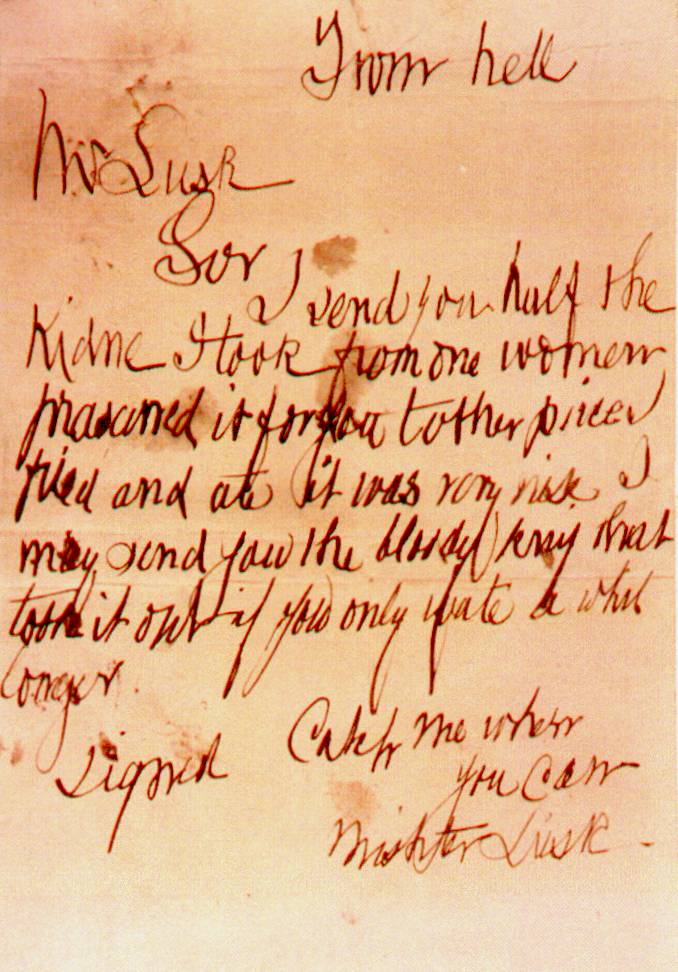
Clearly if both these propositions are true then it's an open and shut case, but they're both patent nonsense. The Ripper letters came from all over the country - indeed all over the world - and were written in a variety of hands. Most Ripperologists (Robinson doesn't much like Ripperologists, mostly because of their failure to spot what is so obvious to him) regard few or none of them as genuine. That's not to say that some or many of them may be genuine, but you really have to make a case for each one of them - not take on a blanket assumption. Hundreds were received and Robinson treats them all as being sent by the murderer - even those which don't even make that claim themselves and are merely letters about the murders.
From Hell
The 'From Hell' Letter
The evidence that Maybrick wrote the letters is insulting to the reader. The letters came from all parts of the country and Maybrick, in visiting concert venues, travelled across the country. But for all that, Robinson offers only one example of an occasion when Maybrick was in the right city at about the right time to coincide with a letter's posting. This should be a rich source of evidence. Maybrick's concerts were widely advertised in newspapers. One might expect a clear analysis cross-referencing letters with concert venues, but none is given. Whether Robinson shunned this kind of forensic approach, or pursued it and decided not to include the results, I don't know.

Robinson explains the letters from the USA by pointing out that someone could board a ship in a British port (say Liverpool), post a letter in the on-board mailbox and then leave the ship. The letter itself would travel to the States, be franked there and then would come back on the next boat, apparently sent from abroad. It may well be that this could be done, but there are still a few dots to join up in demonstrating that it was done, that it was done by Michael Maybrick (rather than anyone else who happened to be in Liverpool sometimes) and that the author was the Ripper.

As to the handwriting, well as Robinson points out:

Michael Maybrick himself had many styles of handwriting, and used many different pens - his table was 'littered with quill pens', noted the New Era article.

There's no direct evidence to support the idea of multiple handwriting styles - but it's evidently a well-known characteristic of people who have several pens.

Even if you ignore the nonsense of travelling from one side of the country to the other in a single day, and having multiple handwriting styles, the fundamental problem remains. Like all evidence based on the letters, it's a case of the Texas Sharpshooter Fallacy. With hundreds of letters to choose from, you're bound to be able to find clues suggesting almost anybody.

-

And that's really it for the case against Michael Maybrick. He was a Freemason who looked a bit like one sketch of a possible suspect. The real reason for accusing him is that he's the brother of James Maybrick - who's a much stronger, though still unlikely candidate. The trouble is, James Maybrick has already been 'done'.

Robinson spends the last section of the book looking at the death of James Maybrick and subsequent trial of his widow, Florence, for her husband's murder. His belief is that it was Michael who in fact killed James and then contrived to frame Florence. In comparison with his charge that Michael was the Ripper, Robinson offers better (i.e. some) evidence, but what's new is not good and what's good is not new. The fact that Florence was innocent has been known widely asserted since the time of the trial and has been covered by many. Robinson provides some reasons to believe that Michael was responsible, but it's not close to convincing. And anyway, the book is supposed to be about demonstrating that Michael Maybrick was Jack the Ripper, not that he killed his brother.
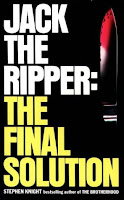
Jack the Ripper - The Final Solution
There are a few positives from the book. Robinson makes a clear case for the incompetence of the Metropolitan Police in investigating the crimes, and conveys it with a evident passion, as he does his description of the inequalities of Victorian London. But this is no substitute for logic and accuracy. He bases most of his Freemasonry theory on work already done by Stephen Knight (in Jack the Ripper - The Final Solution) and others, but then misrepresents Knight's position on many important details, claiming that Knight said:

  • The Duke of Clarence1 was the Ripper. No, Knight said the Ripper murders were done by others to cover up Clarence's morganatic marriage. 
  • Annie Crook, Clarence's supposed wife, was a prostitute. No, Knight says she worked in a sweet shop. (I may be being unfair here. Robinson actually describes Crook as a 'whore' and it's hard to know whether this is meant to be taken literally or is just another of the abusive epithets he scatters through the book.)
  • Martha Tabram was a Ripper victim. No, Knight sticks to the canonical five and regards Tabram as being the victim of a different killer.
  • Catherine Eddowes was one of the women who tried to blackmail the establishment over Clarence. No, Knight claims Eddowes had nothing to do with the blackmail and was killed because she was mistaken for Mary Kelly.

All these may be small errors, but they reflect a sloppy attitude to research. If I can spot all these mistakes in the two paragraphs Robinson writes on a subject with which I am familiar, why should I trust his reporting on other matters with which I am less so?

-

The figure of Clarence and Robinson's habit of flinging abuse at the characters he describes leads on to one of the book's more unsettling, if peripheral aspects. Robinson describes the Duke of Clarence's probable involvement in the Cleveland Street Scandal. Again there's nothing new here - a male brothel on London's Cleveland Street was raided and there was evidence that Clarence had been a client. Homosexuality was illegal at the time, but moreover many of the boys working there were under-age even by today's laws. 

Thus when Robinson describes Clarence as an 'effete little useless pederast' it's possibly true and given the nature of the crime it's difficult to object completely to the level of invective. It's disturbing, however, when his name-calling takes a more generally homophobic turn. Terms such as 'nancy' seem to say more about the writer than the individual described. In discussing Michael Maybrick's motive (that he was gay and therefore - obviously - hated women) Robinson gives us:

I don’t actually know if Maybrick was homosexual, but predicated on that infallible adage, 'If it walks like a duck, etc', he was probably a bit of a ducky.

Aside from the fact that Robinson doesn't 'actually know' very much at all about the case, one can't help feeling that those encounters with Uncle Monty, as told in Withnail and I, left a little bit more of a scar on the memory than we might have imagined.

Uncle Monty
Richard Griffiths as Uncle Monty

Admittedly it's somewhat refreshing to read a book on Jack the Ripper that displays an angry contempt for the failures of Victorian jurisprudence rather than mere historical disinterest, but it should cut both ways. Robinson is at perhaps his most passionate when describing two flagrant miscarriages of justice: Florence Maybrick's conviction for the murder of her husband and the case of William Barrett, tried (though acquitted) for the murder of 8-year-old Johnnie Gill in Bradford in December 1888 (where Robinson can be particularly sure of Barrett's innocence since he knows that the Ripper/Maybrick, in a surprising change of modus operandi, was in fact the killer).

Both Florence Maybrick and William Barrett were almost certainly innocent - there was no more than a hint of a prima facie case against them. Robinson is right to berate those who tried to condemn them.

Perhaps though, in the case of Michael Maybrick where Robinson provides not even that much in the way of evidence, he might consider the plank in his own eye first.


Notes:

1. Prince Albert Victor didn't actually receive the title Duke of Clarence until after the time of the murders, but this is generally how he is referred to.

Monday, 13 April 2015

Come and Visit Your Good Friend Sweeney


Review: Sweeney Todd - English National Opera, London Coliseum.

Sweeney Todd
Dontcha hate it when you're enjoying a show, but the rest of the audience are clearly enjoying it more? Or, more accurately, when the rest of the audience are making it clear that they're enjoying it more? Sweeney Todd at the London Coliseum was a good show, but a standing ovation? What are the audience going to do when they see something really great?

I've seen quite a few Sweeney's in my time, both professional and amateur. The best two were probably the version starring Michael Ball and Imelda Staunton at Chichester in 2011 (later transferred to the Adelphi in London, where I saw it) and The Royal Opera House production of 2003.

Sweeney ToddThe ENO production comes in behind these, but not so very far behind. The most notable feature is that it's 'semi-staged'. This is probably its biggest fault. Sweeney's music and lyrics are among the best of the twentieth century, and stand up easily to concert performance and to recording. On the other hand, the sheer gruesomeness of the razors, the chair, the oven and much more really do lend the story to a full staging. Even the most parsimonious amateur productions try to make some attempt at realism with these aspects.

In being semi-staged, this production fell between the two stools - and worse than that, it opened by deliberately emphasizing the point. Throughout, the entire orchestra is on stage (impressive both visually and aurally) and the show opens with the cast lining up in front of music stands to sing, at which I felt a certain disappointment - but then came the twist. Midway through the opening number, the cast rebel, throw aside their music and stands, kick over some unnecessary set decoration and overturn the unconvincing grand piano to make it into a rostrum as they transform the stage into something more dynamic.

The point seems to be that we don't want this fusty concert staging, we want a full production! I quite agree, but it's a shame that this revolution can only deliver semi-staging. This is Liberal Democrats raging against the Tories, before pusillanimously adding, but let's not go as far as Labour.

That said, some of the staging was very effective. Todd's chair didn't deliver his victims down a chute to the bakehouse; he simply covered their faces with a cloth and let them walk quietly away, which worked fine. I've certainly seen it done worse: an amateur production where victims had to do the 'walking downstairs behind the desk' trick. Ultimately though, the limitations of the staging, particularly in the final scenes, meant that for me the tension did not build quite as well as it usually does.


The big production numbers were generally well choreographed, the best of them being the Act II opener, More Hot Pies, which worked to a climax of Mrs Lovett being lauded by her adoring customers in a style that echoed Marilyn Monroe in Diamonds are a Girl's Best Friend.
More Hot Pies

The on-stage orchestra was used to mixed effect. A plus-point was the interaction with violinists and flautists when Todd and Lovett discuss pies made from fiddle and piccolo players. In some instances, the musicians' equipment was used for props. This worked well when conductor's baton was used as a comb, or when one of the double-bassists' stools was used as Todd's preliminary barber's chair.

But the idea got more strained when musical props were used that did not come from the orchestra. A cymbal was used to represent (geddit?) the dish that pies were served on, but (unless I missed it) this was brought on as a prop, rather than taken from the orchestra. And the kettle drum which Lovett uses as a worktop (geddit? - no, hang on, it's a pie shop, not a tea shop) was twice brought on by stage crew, breaking any real connection with the orchestra. Similarly the trombone used to grind the meat (ged... no, don't even bother) was not taken from a trombonist; it was just an extension of the idea of musical instruments, the concept of why they were there having been forgotten.

By definition though, this was never going to be a production that stands or falls on its staging. Musically, it was pretty top-notch. The orchestra and chorus sounded good, and the supporting cast were generally excellent. Jack North's Tobias managed to avoid the straight-out-of-theatre-school precociousness that such a young role can sometimes deliver. Rosalie Craig's Beggar Woman was too young to make any sense in terms of plot, but a difficult role was excellently sung. 

Emma Thompson and Bryn Terfel
Emma Thompson as Mrs Lovett and Bryn Terfel were both on top form. Terfel's bass brought a strength and sustain to the music that you don't hear in more musical-theatre voices, and his acting was just right in a part that has to be mostly understated, but of occasional devastating passion. Thompson's voice is a contrast in style, and has a clear break in it that I thought would irritate, but which I quickly got used to. She performed the comedy well, but not as well as much of the audience seemed to think.

The jokes in Sweeney Todd I find much like the jokes in Shakespeare: they're witty rather than funny and you've heard them a dozen times before. They need a lot of clever delivery to make them fresh, and while that was often successful, it can't be done on every line. Maybe I do the audience a disservice in assuming they're all familiar with the show, but even heard for the first time, many of the gags just aren't laugh-out-loud funny. And some of the best are impossible to deliver well. For example, Mrs Lovett's 'That's all very well,' after Todd's devastating rendition of Epiphany is impossible to time because of the thirty seconds of applause that follow the song. And yet it got a big laugh - not a reflex, visceral convulsion at the humour, but a demonstration to the rest of the audience that the joke was got. 

It's worth mentioning some of the cuts that were made. The two acts were 85 minutes and 55 minutes, so there was no real tightness on time, which makes me wonder at the reasoning behind some of it. As is often the case, the tooth pulling section of The Contest (don't think Seinfeld) is cut and having seen it both with and without I can't say I feel too strongly either way. 

More unusually though, all the toing and froing over Pirelli's death has gone. Traditionally he's throttled by Todd, but not quite killed, and dumped in a trunk. Then there's various business with both Lovett and Tobias coming up to look for him, while Pirelli's hand waggles, caught in the lid of the trunk, until Todd finally despatches him with the razor. I'm not sure it ever works that well, and probably would do less so in such a big theatre. But what the scene does do is set up the unpleasant ambiguity of Lovett's relationship with Tobias, fulfilled in the second act where her affection for him is revealed as pure sentimentality. As it is, Tobias simply disappears until the beginning of Act II.

The strangest cut, however, is not to include The Tower of Bray in Parlour Songs. While it's never going to be a hit, it's not long and is particularly haunting as a trio with Tobias below in the bakehouse. (This was attempted with Sweet Polly Plunkett, but wasn't contextualized and didn't work so well musically.) Additionally the dialogue around The Tower of Bray provides for some good jokes: 'LOVETT: How many bells are there? BEADLE: Twelve.' - I might even have laughed at that (though I've achieved as much by telling you that I might have).

In the end, it's about expectations. I love Sweeney and I was very slightly disappointed by a production I'd had high hopes for. Impertinent of me though it may be, I suspect some of the standing ovators were overcompensating for similar disappointment. For a seasoned Todd-follower there was plenty to enjoy and, as there always is, a little to criticize too. For a novice, I'd have to recommend full staging - maybe Thompson and Terfel should give it a go.


Saturday, 22 March 2014

The Wicker Man – The Final Cut

The Wicker Man - The Final Cut
Like Psycho and The Planet of the Apes, The Wicker Man is a film for which I cannot remember not knowing the twist.

In the case of those two it’s conceivable that there really never was such a time; the films are so well entrenched in popular culture that I may have known what happens at the end even before I saw them. I doubt the same is true of The Wicker Man. I’d never even heard of it before I first saw it. I must simply have forgotten the experience of discovering for the first time the climax of Sergeant Howie’s visit to Summerisle. That’s a shame, because it’s quite a surprise … and for the benefit of the handful of people who’ve not seen the film I won’t reveal it here.

I first saw The Wicker Man late at night on the BBC sometime in the late 70s or early 80s. This version would have been the theatrical release. By all accounts it was a rushed edit done by a production company that had little confidence in the success of the movie. That said it’s still an extraordinary film and is the version that has primarily given The Wicker Man its reputation and following.
Robin Hardy
In 2002 The Director’s Cut was released; director Robin Hardy made use of unused footage to produce something closer to his original vision. It’s a full fifteen minutes longer. I think I’ve only ever watched this DVD once for the tangential reason that it has no subtitles. My girlfriend is deaf and so our frequent viewings (and believe me, we watch it a lot) have been confined to a DVD of the theatrical release that came free with The Guardian one weekend – but which did have subtitles.

Last year marked the 40th anniversary of the film and saw the release of a new DVD containing three versions of the movie - the theatrical release, the director’s cut and a new ‘final’ cut – along with some documentaries, a CD of Paul Giovanni’s amazing music and even a flyer urging us to get the sheet music for the soundtrack (duly acquired). And it has subtitles.

Recently we watched all three versions back-to-back, and so I thought I’d share my thoughts on the differences.
The Wicker Tree
The director’s cut is the longest at 99 minutes. While one might have an instinct to regard any director’s cut as definitive that’s certainly not the same as saying it’s the best. On the one hand Robin Hardy is clearly a great director because he directed The Wicker Man . On the other hand he wrote and directed The Wicker Tree, which I found to be actually worse than the US remake of The Wicker Man starring Nicholas Cage – harsh words I know, but I stand by them.

One gets the impression that the director’s cut has tried to use every inch of footage that could be found. In many cases just a few seconds are added to the beginning or end of a scene. I’d have to question whether there really was any benefit in putting these back in, but equally I can see no reason for taking them out in the first place. In terms of the director’s cut as a film in its own right, however, there is the problem that the quality of the inserted clips is much lower than that of the theatrical release, so they do rather stand out. In a sense that’s an advantage in that it makes it easier to spot the differences. The final cut doesn’t obsess quite so much on restoring every last second and also has better quality restoration, so the extra material is less obvious – but not invisible.

The two major differences between the various versions come in the film’s opening and in the events of the two nights that Howie stays at the Green Man Inn.

The theatrical release opens with the titles showing over Sergeant Howie’s flight from the mainland to Summerisle, accompanied by Paul Giovanni’s eerie adaptation of The Highland Widow’s Lament, seguing into Corn Rigs . The director’s cut begins with quite a long section on the mainland revealing Howie’s religiosity and virginity and presenting the story of the arrival of the letter summoning him to Summerisle. The final cut has a very short sequence showing Howie in church, before going into the titles. One gets the feeling that both the later cuts are somewhat restricted by the fact that the only print available has the titles over the flight to Summerisle and that the option of completely putting them elsewhere is not available.

With regards to the opening I have to say that the theatrical release wins hands down. This is a film about a clash of cultures and therefore it should begin with the point at which those cultures meet. We know as little about Howie (aside for our preconceptions based on his uniform) as we do about the islanders. Placing all the action on Summerisle conforms to the idea of Aristotelian unity of place.  Almost all of what is covered in the director’s cut (which reminded me of a dull episode of Z-Cars) is dealt with in seconds by Howie saying he is looking for Rowan Morrison and showing the islanders the letter and the photograph. His religious life is dealt with neatly in flashback.

Islanders

The final cut appreciates that most of the setup is unnecessary, but still puts in a very brief sequence of Howie in church on the mainland before going into the standard titles. It’s a compromise and an unnecessary one. The theatrical release gets it right: it hits us straight away with the visual spectacle of the view from the seaplane, the sound of the traditional folksong and the concept of a policeman going somewhere to do something. Anything before that is mere distraction.

The nights at the Green Man change quite substantially. In the theatrical release Willow tempts Howie on his first night at the inn and nothing much happens on the second night. In the other two versions the temptation occurs on the second night. The first night covers probably the biggest cut from the theatrical release. Lord Summerisle stands outside the inn and presents a young man to Willow to achieve his manhood with her. While they are together Lord Summerisle outside recites a speech beginning ‘I think I could turn and live with animals’, based on a poem by Walt Whitman, and there are strange, symbolic shots of a snail on a leaf.
Willow
Clearly this is an important scene, both in establishing the sexual permissiveness of the island in general and of Willow in particular, and of showing Lord Summerisle as completely integrated with that aspect of the island’s life. However, I think its inclusion is a mistake.

In the theatrical release Howie (and the audience) first meets Lord Summerisle after this first night. Summerisle seems modern, affable and tolerant. In contrast with Howie he appears to be by far the more reasonable man. This doesn’t work if we the audience already know just how weird he really is. As the film progresses Summerisle still stands out as a beacon of sanity – as someone who indulges the island’s religion to just the extent that on the mainland he might indulge Christianity without having any real conviction for it. It’s only at the end, after Howie appeals to him, that we discover that he genuinely believes.

A compromise might have been to swap the events of the two nights, so that we still get to initially see Lord Summerisle as a reasonable man. I can’t say whether that was considered, but I doubt whether it would have been achievable with the available footage. Even so, it would spoil the track of our appreciation of Summerisle’s character as the film progresses.

One minor scene is interesting. Only in the director’s cut does Howie seek out the island’s doctor and ask about the death of Rowan Morrison. It is the doctor who refers him to the Public Records Office. It’s a very short scene, but it makes sense in that the doctor is the person a police sergeant would ask. I’m surprised it wasn’t included in the final cut.
Christopher Lee
There’s one area in which I’ve always expected to see more footage and never have in any version. On the morning of Mayday Howie conducts a house-to-house search for Rowan. This has always seemed a little rushed to me and looks as though it’s been cut down from a longer (quite conceivably too long) sequence. To site a particular event, there is a point where Howie goes into a bedroom, pulls back a curtain and reveals a stone spiral staircase leading down. It seems obvious he will go down there to continue his search, but in the theatrical release he does not. It’s always bothered me and so when I first saw the director’s cut I expected to see what was down there, but the scene is just the same, as it is in the final cut. I can only presume that footage of him going down the steps is unavailable, but I’d have to question why none of the versions have thought to cut the spiral staircase completely and not leave this issue hanging.

That said I do think the search sequence (with only very slight differences across the versions) works and needs to be as pacey as it is – it just does have the feeling that it was cut down from something less slick rather than having originally been written and directed in its current form.

In the end the only significant differences across the three edits are the pre-title sequence and Lord Summerisle’s speech outside the Green Man. The story is that British Lion was not keen to release the film at all and did the edit for the theatrical release simply to have something that they could distribute. That may be true, but it doesn’t necessarily mean they made a bad job of it.

The opening of the film seems to me unquestionably best in the theatrical release. The scene on the first night is more debatable, but overall I think the story flows better without it.

I’ve watched The Wicker Man many times and I will again in future. And for variety I will probably watch all the versions. But the one I’ll watch most – the one I’d recommend – is the theatrical release.

Monday, 13 February 2012

Review: The Autobiography of Jack the Ripper

The Autobiography of Jack the Ripper by James Carnac.
Bantam Press 2012.

This review contains spoilers.


When I'm chatting to religious types, as I'm prone to do, one question which often comes up is why they believe that the Bible (or whatever their tome of choice may be) is the unadulterated word of God. There are many answers, but a lot of them boil down to the simple logic: it is the word of God because it claims to be the word of God. Now while it may be easy to see the circularity of such an argument, it does act as a reminder of just how many books are out there that claim to be something that they are not. My favourite is Umberto Eco's The Name of the Rose, in the foreword of which the author recounts the story of his discovery of a manuscript by the Benedictine monk, Adso of Melk. Eco, so he claims, is merely the story's translator. (As Paul Begg points out in his notes on The Autobiography of Jack the Ripper, George MacDonald Fraser made a not dissimilar claim when introducing Flashman.)

And so James Carnac's 'autobiography' comes with its own foreword, describing how it fell into the hands of its discoverer, Sydney George Hulme Beaman (famous not least as the creator – I kid you not – of Larry the Lamb).

If the subject were not the Whitechapel Murderer, I doubt whether the question 'is it genuine' would ever come to mind. Had it not been for the emergence, two decades ago, of James Maybrick's supposed diary, would the world of Ripperology spend any of its valuable time considering if James Carnac (of whom no historical trace has been found) were actually the Ripper? To be honest, not too much valuable time has been spent. The noted Ripper expert Paul Begg gives us 30 odd pages of quite reasonable analysis, but leaves many potential lines of enquiry unexplored (or at least his exploration unreported). Even if the name of every character in the book had been changed, it would still not be too hard to find reports of the inquest of a doctor (Carnac's father) in Tottenham who cut his wife's throat and then his own, nor of the road accident in which Carnac lost a leg, nor of his death in a gas explosion near Russell Square. But such enquiries would take time and effort, and although Begg has in the past shown his skill and willingness to put these into an investigation, it must be hard to find inspiration when one knows that all clues will come to nothing. Carnac's work screams from every page that it is a work of fiction.

Which is not to say that it is a fake. People often say that the Turin Shroud is a fake, but what they really mean is that they are now convinced that it is not something that they once suspected it might be. To be a fake, it must be proved not to be what its creator intended people to believe it to be. If the Turin Shroud turns out to have been a cover for the tortured body of Jaques de Molay, or an early experiment in photography by Leonardo da Vinci, then it will genuinely be that thing, and not be a fake anything else. The fakery is only in the minds of those who want to believe.

Thus The Autobiography of Jack the Ripper is no fake. It is merely a work of fiction with a forward that is intended to add verisimilitude, much like The Name of the Rose or Flashman. As a work of fiction, how does it stand up?

To be clichéd, it's something of a curate's egg. The story is divided into three parts – Carnac's early life, the Ripper murders, and the events leading to his death. Of these, the first part is by far the best. Despite the author's repeated (and perhaps telling) insistence that he has no skill in writing, there is good pacing and some nice turns of phrase. The story covers the gruesome death of his parents, his own growing bloodlust, his conversations with the mysterious 'Voice', his discovery of his family's macabre history and his encounter with the embodiment of the evil that has haunted every generation of his ancestors.

Great stuff! And whilst not approaching the quality of H.P. Lovecraft or M.R. James, it's of the same kidney. Part two, covering the Ripper murders themselves, disappoints. Here one might almost suspect that the author genuinely is trying to convince us that he is the Ripper. As a writer of historical fiction, I know that is better to add invented detail to make a scene more convincing and that I will get little comeback for minor inaccuracies. However, the cursory coverage of the murders in Whitechapel suggests an author who fears getting caught out in his mistakes. Even then, as Paul Begg points out, he does make many mistakes – often ones that would have been easy to check.

But the real problem of part two is its failure to deliver on Carnac's motivation. Part one has convincingly told us of his growing desire to see and feel a knife cutting into living human flesh, and told us that this was to be the reason for his becoming the Ripper. But once he does kill, we hear nothing of his reaction to finally committing the act to which he has so long been drawn. Nor is there anything to explain how a desire simply to cut a human throat spirals into the squalid, uncontrolled evisceration to which the Ripper descended at Miller's Court. In his foreword, Hulme Beaman tells us that he has 'removed and destroyed portions of the manuscript which contained details particularly revolting to me.' It should be noted, that there is no trace of any such censorship of the typescript (which, I add in passing, is irritatingly referred to as a manuscript throughout the book). This sounds to me more like an author's pretended excuse for not going into a level of detail that he guesses would be unacceptable to his readership, but in reading part two it almost seems that the author has forgotten the groundwork he laid in part one, or that part two was written first, or perhaps even by a different author.

Part three is different again. It is a short tale of a murderer hoist on his own petard, for which there is no real requirement that the murderer be Jack the Ripper. The events take place forty years after the Ripper murders – close to the time the document seems to have been written. This section begins like the rest as a first person narrative, but the twist in the tail is delivered as a separate coroner's report, thus neatly avoiding the necessity for Carnac, like Moses, to be the narrator his own death. The problem here though is that this seems to defeat the conception of the entire work as being an autobiography. One would at least expect a further note from Hulme Beaman explaining his later discovery of the coroner's report. Perhaps that would be just too pat. What is confusing though is that the coroner's report was written out using the same typewriter as the last part of Carnac's autobiography.

Ultimately my guess would be that the autobiography is in fact an amalgamation of three short stories – or perhaps even two, with the middle Ripper section added rather cursorily to link them and to increase public interest. While this does still leave questions, many of which Begg raises, over numerous inconsistencies even this is taken as a work of fiction, I don't see any of them as particularly serious. We all from time to time (or is it just me?) send half-baked ramblings to our editors in the knowledge that we'll have the chance to iron out the wrinkles later on. Moreover, there's nothing to suggest that this was the final revision of the work. Hulme Beaman died in 1932, only a few years after the document's presumed date, so it may have been a work in progress.

In the end, I think that this is a book that may appeal more to the aficionado of early twentieth century horror than to the Ripperologist. Luckily, those are two groups between which there is a substantial overlap, which includes myself. The biggest question that remains for me is whether Hulme Beaman really is the author of this work of fiction, or whether he added his foreword to the work of another.

Personally, I like to think that Hulme Beaman wrote it himself. It's a heck of a lot better than Larry the Lamb.

Friday, 27 February 2009

Death to the eight-legs! ... er ... six-legs!

CONTAINS SPOILERS


I've just finished reading Dennis Wheatley's 1948 novel, The Haunting of Toby Jugg, and while I guess it's over half a century too late for me to be offering a full review, there is one very important question that the book raises:

Did Dennis Wheatley genuinely believe that spiders only have six legs?

Our crippled hero, 'Toby', is haunted by a supernatural creature which at first he can only see vaguely, in shadow. His initial suspicion is that it is some kind of octopus, but when he manages to make out that it has only six legs, he realizes that that can't be the case (so clearly Wheatley's malacology is better than his entomology, although there's a clue in the word 'octopus', so maybe it's just a case of etymology).

Later on, it's revealed to him that the creature is a spider, albeit a giant one, summoned from Hell itself. As Toby describes it in his diary:

I now knew what it was that had thrown the Shadow. That round body and the six hairy, tentacle-like legs had been those of a spider without a doubt; but a spider the likes of which has never been recorded in this world.

Now, just because Toby doesn't know how many legs a spider has, doesn't mean Wheatley didn't. Perhaps the spider's missing limbs echo the paralysis of the hero's own two legs; if so, nothing is mentioned. Possibly the explanation was lost in an edit (if so, I'm pleased to say that copy-editing has improved vastly over the years - I'd never get something like that past them).

Or maybe Wheatley had just never bothered to look at a spider.

The cover illustration (Wordsworth Editions) certainly shows a spider with sufficient limbs to play Tarzan four times over, as does as least one other edition. Actually, this is a bit of an irritation. The fact that the creature that haunts Toby is a spider is meant to be something of a surprise when revealed (maybe the leg-count is deliberately intended to deflect our suspicions), and so the cover is a bit of a spoiler. Also, the illustration shows Toby on crutches, rather than in wheelchair, which is his sole transport in the text. But now I'm getting picky.

The biggest shock of the book is that not only is the villain a Satanist, but also a Communist, and that, in fact, the latter ism is and always has been merely a front for the former. Now this is something that I, like any right-thinking Englishman, have long suspected, but while Toby takes the Satanism pretty much in his stride, its the Communism that comes as the real shock. I mean, summoning gargantuan, leg-deprived spiders to scare a paralysed airmen into madness is one thing, but the workers controlling the means of production? Well, really!

Despite all this, it's still a fun read, certainly if your can accept it as an artifact of its time. There are some lovely passages within, such as:

Her blue eyes blazed, and she retorted: 'If you were not, one - a cripple; two - my patient; and three - suffering from erotomania, I would slap your face.'

I must try to slip that into my next novel - no one will notice.