Tuesday, 17 July 2018

The House of Special Purpose

The Romanov Family
Nikolai II and his family.


One hundred years ago today, on July 17 1918, the deposed tsar, Nikolai II, was murdered, along with his wife, his son and his daughters, at the 'House of Special Purpose' in Yekaterinburg, Russia. In my novel The Last Rite, our hero, Mihail Konstantivich Danilov meets Nikolai earlier that year, and has a vision, through the tsar's own eyes, of his approaching fate.


Instantly I was in a different place. A narrow stairway leading down to a cellar. It was night – the early hours. In my arms I was carrying a boy. He was thirteen years old, but small for his age, weak, ill. There was a queue of us on the stairs, but soon we were in the cellar. There wasn’t much room, not for eleven of us. I looked at the faces around me. My wife was there, and my four daughters. The four others were the only ones who had remained loyal to us; my physician, a footman, a maid and a cook. Around my ankles scampered my little spaniel, Joy. She had remained loyal too. I turned round, back towards the stairs. They’d said we were being evacuated. Evidently we would have to wait here some time.
            ‘Could you bring some chairs?’ I asked.
            The man standing at the bottom of the stairs, our gaoler, shouted up. Moments later three hard wooden chairs were brought down. I placed my fragile son in one and offered the second to my wife. I took the third. Then the room began to fill, with more men coming down the stairs. Soon the little cellar was preposterously crowded. I had to stand up again, just to see what was going on. There were eleven of them, not counting our gaoler, the same number as there were of us. That in itself was suspicious. They tried to spread themselves through the room, each pairing off with a single member of my family or our entourage, as if fulfilling the promise made on some fantastical dance card. But in the cramped space it was impossible to move anywhere.
            The gaoler cleared his throat. He had a piece of paper in his hand which he read from.
            ‘In view of the fact that your relatives are continuing their attack on Soviet Russia, the Ural Executive Committee has decided to execute you.’
            I turned quickly to look at my family. ‘What?’ I whispered. ‘What?’
            The gaoler repeated the sentence, reading it again, though it was short enough for him to remember by heart. I wondered where they would take us to perform the act, how much time we had, whether they would separate us – the men from the women, the adults from the children. I began to pray that in the coming hours we would have time properly to say goodbye.
            But the gaoler had scarcely finished speaking when his hand emerged from his pocket holding a revolver. He was standing just two feet away from me. He fired and I felt a thump against my chest. My legs grew weak and I began to fall. The gaoler fired again, but not at me. I heard my little boy scream and then fall silent. Until then I had felt no pain, but now every agony shot through me. I could not move, I could not speak, I could only perceive, and I knew that that would not last more than a few moments.
            The other assassins had rifles rather than pistols and they began to fire. Bullets ricocheted across the cellar. Bodies fell – I could not see who – and the monsters finished them off with bayonets. I tried to breath, but could not. Nor did I want to. My heart had been still for seconds now, blown apart by the bullet. My eyes gazed out across the cellar floor, across the pools of blood to where the spaniel pawed at the dead face of my beloved son. I tried to reach out to him but I knew there was no point. My only consolation was that we had died in the same moment.

Saturday, 8 October 2016

Sweeney was Smooth – Sweeney was Subtle

Review: Sweeney Todd: The Demon Barber of Fleet Street.
88 London Road, Brighton, 4 – 29 October 2016.


Aficionados of this weblog may note a couple of disturbing trends: the only books I seem to review are about Jack the Ripper and the only shows are productions of Sweeney Todd.

Perhaps this reflects something of my macabre predilections, but the basic reason is that I only like to review subjects that I really know something about, and I’ve seen sufficient productions of Sweeney Todd to make even professional stick-shakers back away in fear.

There have been big productions of Sweeney Todd and small ones, and director Conor Baum’s interpretation is definitely at the small end of the scale, with just eight actors covering all the roles and the work of the chorus. Productions of this size can flounder, but Baum exploits the limitations entirely to his advantage. The small, claustrophobic space at 88 London Road is perfect for the gothic atmosphere and is used flawlessly to convey the variety of scenes visited as the story progresses, whilst maintaining its centre of Todd’s tonsorial parlour glowering above Mrs Lovett’s pie shop down below.

The mechanics of that set are vital to any production of Sweeney. It needs to work for Pirelli’s semiconscious body in the trunk, his hand reaching out and grasping; for delivering Todd’s victims down from his chair; for those victims to arrive in the cellar below. And on top of that we need a convincing bake-oven to boot. For any production that does not have an infinite budget, these can be a sticking point. Some ignore the problems; others bodge the solutions. Here, Cath Prenton’s set combined with some clever direction worked excellently, showing those things that could be achieved on stage and smoothly allowing our imaginations to fill in what couldn’t.

The cast did astonishing work in covering their own main roles plus countless minor parts. All sang wonderfully, though some seemed to get into the skin of their character a little better when singing than when speaking. Clear exceptions to that would be Alice Redmond (Mrs Lovett), Samuel Clifford (Beadle Bamford) and Alistair Higgins (Tobias), all of whom gave entirely convincing performances throughout. Indeed, Higgins was one of the best Tobys I’ve seen, avoiding the pitfall of being too sweet and just a bit too ‘musical theatre’. Anthony is always a difficult role to cast, and while Dale Adams sang it wonderfully, his presence on stage was more than a little too graceful to fit in with the grittiness of the rest of the cast. A bold but effective decision was made to cast Rebecca Bowden as both the beggar woman and Adolfo Pirelli. Pirelli requires a high tenor voice which is sometimes rewritten or simply fluffed. It was wonderful to hear Bowden hitting those notes clearly and beautifully – a full octave higher than the score. 

Alistair Higgins
Like the cast, the orchestra was similarly pared down to just three: cello, keyboard and piano, from which musical director Ellen Campbell conducted. At times this led, understandably, to a few gaps in comparison with the Broadway recording with which many in the audience will be familiar, but at others it was fascinating to hear individual musical lines that are often lost in the hubbub. The same was true of the choral numbers performed by just eight voices. Here nothing was lost (except perhaps the occasional oomph of a choir of sixty emitting a forte fortissimo ‘Swing your razor wide, Sweeney!’) and everything was gained. Each vocal line was clear and could be appreciated either on its own or as part of the overall harmony. As anyone who has sung them will know, these choral numbers are fiendishly tricky, and without exception the cast performed them brilliantly, in many cases with only a single voice on each line. As far as I could tell the score was complete with the exception of the tooth pulling (which is commonly cut) and The Tower of Bray, which I have to say I’d have liked to hear.

Alice Redmond
For any show as well-known as Sweeney cast and director must be working constantly to keep things interesting for an audience who for the most part know exactly what is coming next. Here there were always subtle and interesting things going on, such as the changing newspaper headlines for each scene and indeed the whole setting of the story as being some kind of newspaper report. And it’s always a treat to hear a new joke in a familiar text, in this case from Alice Redmond – prima inter pares of a hugely talented cast – during By the Sea with ‘I’ll be there slipping off your [pause] slippers.’ It may have been done before, but it was new to me.

I’d always recommend to someone who’s never seen Sweeney to go and see almost any production, including this one. The stronger recommendation is to those who have seen the show before – and Brighton’s full of them. This production really will add something to your appreciation of the show. And the good thing is it runs till the end of the month.


Links

88 London Road's website.
My review of English National Opera's 2015 production of Sweeney Todd.

Thursday, 6 October 2016

A Toe in the Water – Part One

Self-publishing.

Sounds a bit like self-publicity, doesn't it?

Others may disagree, but I think I'm rather poor at the latter (though I'm trying to do better, literally at this very moment). The question I'm currently contemplating is whether or not I'll prove to be any good at the former.

Late Whitsun Cover
My new detective novel Late Whitsun is due out next Thursday, October 13th. Everything’s ready to go, pretty much, and so now I’m faced with a hiatus; the calm before the … well, let’s hope for some kind of storm.

And so now would seem like a good time to share my experiences so far, and I choose this moment before publication specifically because I have no idea whatsoever if what I’ve done will prove to be effective or otherwise. The proof of that pudding will be reported here later in A Toe in the Water – Part Two, when I hope to be describing the spectacular success of the whole venture – or its desperate failure – or something betwixt the two. Then, perhaps, will come Part Three in which with the wisdom of hindsight – the only kind there is – I’ll look back and consider what I should have done. Hopefully it will consist of just four words: ‘Exactly what I did.’ Some hope.

But for now my head is still full of what I’ve been working at over the last few weeks and months: the mechanical rather than creative process of turning the original script into something that can be sold to and read by the world at large. I’m lucky in that I’ve have previous books that have gone out through a mainstream publisher (The Danilov Quintet from Penguin Random House). That means I know what needs to be done – know what the steps are and to some extent have seen others performing them. There are pros and cons of having people to do things for you. Obviously it’s less work, but sometimes you have to bite your tongue when you think you can do better. Doing it yourself means doing everything yourself – or delegating it, though it’s still your responsibility. Some of those tasks are fun, others tiresome.


Danilov Quintet Covers
The Danilov Quintet

So here’s what had to be done:

First, as Mrs Beeton might have put it, write your novel. I hardly need to go into how you do that – it’s very simple – but it does count as one of the fun tasks and no one else can do it for you (James Paterson notwithstanding).

Second, in discussion with various mainstream publishers decide that self-publication is the best route for you. Again, we don’t need to go into details, but switching genres (in my case from horror to crime) is a big factor here.

Third, get feedback. The problem is not finding people who’ll read your work, but finding those who’ll give you honest, useful feedback. The risk is that your friends and relations will be wary of causing offence, and may not have the expertise to judge anyway. Again, I think having been published previously helps here for several reasons: it gives you a better idea of how to fix any problems identified, it gives you a better idea of who to get feedback from and it makes it easier for the reader to treat you as an author rather than just as a friend. On this front I have particularly to thank Katie Piatt, Chris Horlock and Helen Casey.

Fourth, get the script copy-edited. This is a job for a professional. You can find organizations who will do this for a fee online, though I was lucky enough to have a friend (the inestimable Peter Lavery) who is an expert at such things. It’s always astonishing to discover from a copy-edit just how much rubbish one is capable of writing – and reading again and again without noticing. Even if you don’t agree with the editor’s suggestions, the benefit is that you are forced to think individually about every sentence – every word – you’ve written.
The Copy Edit
The Copy Edit
It’s worth noting a subtle but significant difference in the process here between self-publishing and going through a publisher. With a publisher, you get the copy-edit and you go through it and approve, alter or reject the changes suggested. Your notes go back to the publisher and get incorporated into the script. When you’re self-publishing, every change you make has to be incorporated into the script by you yourself – extra work for you. It can make you tend to reject more of the suggestions than you might have done, but it does also encourage you to think in depth about all of them.

Fifth, proofread. You have to do this yourself, but it’s essential to get others to do it too. Call in favours and perhaps call in professionals.

Sixth, choose your platform. Maybe I should have though more about this one, but went for Amazon (Kindle Direct Publishing for e-book and Create Space for print) on the basis of ‘No one ever got fired for choosing …’ (A phrase originally applying to IBM – whatever happened them?) I’d originally thought Kindle only, but using Create Space for a print version is only a little more effort and it seems like a waste not to exploit all the effort you've put in so far.

Seventh, proofread again.

Eighth, design a cover. For me, this is one of the really fun bits. I’ve absolutely no artistic talent, but I have become pretty handy with Photoshop. Alternatively, platforms like Kindle Direct Publishing (KDP) provide some good cover templates, but even then I’d suggest doing some customization yourself. Again there are companies online which will do this for you, but by the look of a few such covers I’ve seen, they really don’t have their heart in it like the author would. Obviously you can get someone to do it for you, but a good cover image would be expensive. As with things like the copy-edit, pull in favours if you need to.

The First Blurb - By Gelett Burgess
The First Blurb
Ninth, write your back cover copy – your blurb. Odd word that, but used throughout the industry (see here for its origins). I’ve seen companies offering to do this for you too, but that seems very odd to me. If you can put together the tens of thousands of words that make up a novel, you ought to be able to manage a couple of paragraphs to sell your story. I suppose my publishers would have written the blurb for me, but I’ve always done it myself, in collaboration with my editor. And bear in mind, of course, that’s it’s not just going on the back cover – the kindle edition won’t even have one. This is what is going to make people want to read your book.

Tenth, proofread yet again. It always astounds me how many minor errors I find on every iteration of proofreading. For me it’s mostly missing words (‘he went the shops’) mistaken words (‘it was and very interesting book’) and homophones (‘it was all to much’). I think I’m more aware of them when self-publishing. With a publisher the last time I read my work is with the page-proofs and I might catch a few mistakes there, but I know that a team of professional proof-readers is also going through them. I presume they do a good job, but I can’t say for sure, since I’ve never read the final printed version of one of my own books. It’s always been someone else’s problem. Now it’s my problem.

One thing I’ve always done is read the text out loud, usually at least twice, once much earlier in the process while I’m still drafting, and again at around this point. It’s good for checking that the style is working, particularly with dialogue, but it also tends to catch different kinds of mistakes from those you’ll find when reading to yourself. But still errors get through, because you autocorrect as you’re reading, before the words even get to your conscious mind. For this book, I tried a further trick of using text-to-speech software to read the book back to me. The software makes no mistakes and then you process it with a different part of your brain (I reckon) from when your reading. I certainly caught a few errors this way – though obviously not those of punctuation and homophonic spelling. Don't get too depressed by the monotonous delivery making your story sound dull.

The Formatted Page
The Formatted Page
Eleventh, format. At this point your script is going to split into an e-book version and a print version. That means you really want to have finalized your text by now – from here on any mistakes you discover (and you will) will have to be corrected separately in both versions. The e-book version is fairly easy, since the actual formatting is done on-the-fly by the e-reader itself; just follow the guidelines that KDP (or your chosen provider) gives. Print formatting is more work and actually, I found, rather fun. You can download a template, but then you’ll have to copy over your text and fit it to the new page size. For me it’s interesting work and the exciting thing is that at this point your work starts to really look like a book – the same as when you get page proofs from your publisher.

Twelfth, yes, proofread again. All that mucking around with formatting, you’re bound to have made some mistakes.

Thirteenth, upload. This is pretty quick and easy. For both e-book and print you’ll then be able look at an electronic version of the finished product. For an e-book, this is exactly what your customers will be getting, whereas of course for the print version it’s not quite the same thing. Order a physical proof for one last check, not so much for content but for formatting, cover and print quality. Mine’s due to arrive later today.

Quick rant here. Amazon’s Create Space charges for proofs and other author copies; that’s perfectly fair. They also charge for postage for these copies; again, no problem. However, they only print these copies in the USA, so the shipping costs to the UK are huge, particularly if you want to get them in any reasonable timescale. Customer copies are printed in the UK, so it’s not a problem in that case, but I’ve found no good reason they can’t do that for author copies.

And finally, publicize, which is perhaps a better subject for a later article. For now, I’m following the advice of others: get reviewed online, use social media, tell your friends.

And, of course, blog.


LATE WHITSUN is available from Amazon.


Wednesday, 5 October 2016

Press Release - Late Whitsun

PRESS RELEASE

LATE WHITSUN

by Jasper Kent 

Published October 13th 2016 

Late Whitsun Cover
Bestselling horror author Jasper Kent turns to crime fiction with LATE WHITSUN, the first in the Charlie Woolf series of mysteries.

Set in Kent’s adopted hometown of Brighton, not long before the outbreak of World War II, LATE WHITSUN combines elements of Agatha Christie, Raymond Chandler and Graham Greene to produce a refreshingly new style of whodunit.

Brighton, 1938 … 

Charlie ‘Big Bad’ Woolf thought it would be easy money, and there’s precious little of that for a private detective in a seaside town. It was just a trip up to London to hand over an envelope – a favour for his old partner, Alan O’Connor. But Woolf couldn’t resist taking a peek inside.

The pictures were unadulterated smut; a man and a girl in a hotel room. Blackmail, pure and simple – right up O’Connor’s street. Woolf was happy to be rid of them, handing them over to a masked man in a London park.

When he gets home, O’Connor’s waiting for him, which is a surprise. The bigger surprise is that he’s dead; a bullet through the eye. Woolf is the prime suspect, but when he discovers that the man in the photographs is a German diplomat and the blackmail is being run by MI5, things get more complicated.

It seems obvious who killed O’Connor, but Woolf soon realizes that he’s the only one who cares. With war looming, the good of the country counts for more than the arrest of a murderer. If he’s to see the killer caught, Charlie Woolf must prove that the crime has little to do with the world of espionage …

Jasper Kent Headshot
About the author: 

Jasper Kent was born in Worcestershire in 1968, studied Natural Sciences at Trinity Hall, Cambridge, and now lives in Hove. TWELVE, the opening book of his historical horror series THE DANILOV QUINTET was one of the bestselling debuts of the year. As well as writing novels, Jasper works as a freelance software consultant. He has also written several plays and musicals.

 In addition to other projects, Jasper is planning two more Charlie Woolf novels: THE STALACTITE MAN and TO MUDDY DEATH.

To find out more, visit www.jasperkent.com.


Acclaim for Jasper Kent’s DANILOV QUINTET:

‘An accomplished, entertaining blend of historical fiction and dark fantasy.’ – THE TIMES

‘Rich historical insight and compelling storytelling.’ – WATERSTONE’S BOOK QUARTERLY

‘A bloody good tale.’ – PUBLISHERS WEEKLY

‘Leaks Russia from its very pages.’ – SAN FRANCISCO BOOK REVIEW

‘You will love Jasper Kent for all eternity. I sure do.’ – ELITIST BOOK REVIEWS

‘A brilliant book.’ – HISTORICAL NOVEL SOCIETY


Jasper Kent is available for interview.

Review copies (print, PDF or MOBI) on request.

Contact:

info@jasperkent.com

Saturday, 21 November 2015

Review: They All Love Jack


They All Love Jack - Busting the Ripper by Bruce Robinson
Fourth Estate 2015


They All Love Jack
Bruce Robinson - best known as the writer and director of Withnail and I - believes that Michael Maybrick was Jack the Ripper. The question is: why?

Not why did Maybrick do it, but rather: why does Robinson believe it?

I've read enough Jack the Ripper books in my time for me not to expect the cut-and-dried proof of culpability that is so often promised by overoptimistic subtitles along the lines of The Final Chapter, The Final Solution or Case Closed. I'm just looking for a reasonable case to be made, which might lead others to investigate further, perhaps to bolster the case, perhaps to refute it.

To that end, I find a good starting point is to discover why the authors first came up with their initial suspect - why they believe they've finally cracked it. In the case of Paul H. Feldman and others who suspect James Maybrick it's pretty obvious: the discovery of a diary which, if genuine, inescapably suggests James Maybrick was the Ripper. In the case of Patricia Cornwell suspecting Walter Sickert it was because ... er ... someone mentioned to her that he was already a suspect.

Walter Sickert and James Maybrick
Suspects: Walter Sickert and James Maybrick

And so something must have led Bruce Robinson to suspect Michael Maybrick, yet he never mentions what it was. One can only assume that the reason is the obvious one: that Michael's brother James was already a suspect, but since the initial suspicion is such a large part of why an author believes in their case, it really should be shared with the reader. Not to do so seems to be an attempt to portray a false aura of impartiality. Cornwell attempts much the same trick, leaving unmentioned virtually any of the books that had gone before, both those that claim Sickert was the Ripper and those that refute it. Robinson does discuss the diary, but never makes clear if it, or anything else, was his starting point.

But it's not where you start it's where you finish, and Robinson's starting point doesn't much matter if in the end the case against Michael Maybrick is clear. Not iron-clad; simply clear.

The problem is that in all of the 800 plus pages, Robinson doesn't even attempt to make a case against Maybrick. The best I can pull together is this:

1) The Ripper was a Freemason. Michael Maybrick was a Freemason.

Personally, I think there is a case that the Ripper might have been a Mason. It's not strong and there's nothing much here that's not been derived from previous works on the subject, but it's possible. Robinson certainly produces clear evidence that Maybrick was a Mason. But the problem is hardly worth pointing out. Robinson himself spends pages bewailing the fact that British society was riddled with Freemasons. The Ripper connection could point to any one of them. Again the question arises: why Michael? Again there is no answer.

2) Michael Maybrick matches one of the few eyewitness descriptions.

Robinson spends a lot of time discussing how the police either ignored or suppressed the evidence of Matthew Packer, a fruiterer who claimed to have seen a man accompanying Elizabeth Stride shortly before her murder. Given Robinson's belief that the police - particularity Commissioner Sir Charles Warren - were trying to cover up the the true culprit, Packer's testimony takes on additional significance. Sketches were published based on Packer's description, and certainly one of them looks a little bit like Maybrick.

Packer's Suspect
Sketches from the Daily Telegraph 6/10/1888

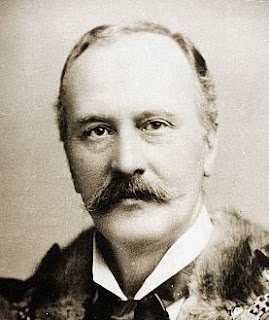
Michael Maybrick
Michael Maybrick

Evidence at last?

Clearly not - and for the same reason that the masonic link is not evidence: thousands of people could roughly match that sketch. Indeed, a vagrant called John Langan was arrested in Boulogne on the basis of the sketch, and later found to be innocent. Or was it Joe Barnett, Mary Kelly's lover, and for some a Ripper suspect?

Joe Barnett
Joe Barnett

The sketch is so rough it could be any one of 10,0000 men. But the problem for Robinson is more profound than this.

Packer did not just provide a sketch. He watched Stride and the man standing side-by-side for almost half an hour and described the latter as between 30 and 35 years old (younger in some versions of his statement) and of medium height (5'7"). Michael Maybrick was 6'1" and 47 years old at the time of the murders. Packer may or may not be a reliable witness, but whatever testimony he offers, it stands against the idea that Maybrick was the Ripper.

3) The Whitechapel murders cluster around Toynbee Hall.

They certainly do. Toynbee Hall was (and is) a charitable welfare centre at the heart of the East End. At the time of the murders it was often used as a venue for concerts and other entertainments for the local people. Michael Maybrick - by profession a singer and composer - might well have gone there to perform. Indeed Robinson offers much evidence to demonstrate that several of Maybrick's friends and colleagues did visit the hall. And yet he offers no direct evidence that Maybrick himself was ever there. That's not to say that Maybrick was never at Toynbee Hall, but whatever evidence there is would surely point to one of those we know was there - several of whom were Freemasons - than to someone who may or may not have been. And even then, Tonybee Hall is far from being the only building in Whitechapel which the the Ripper might have used as his lair.

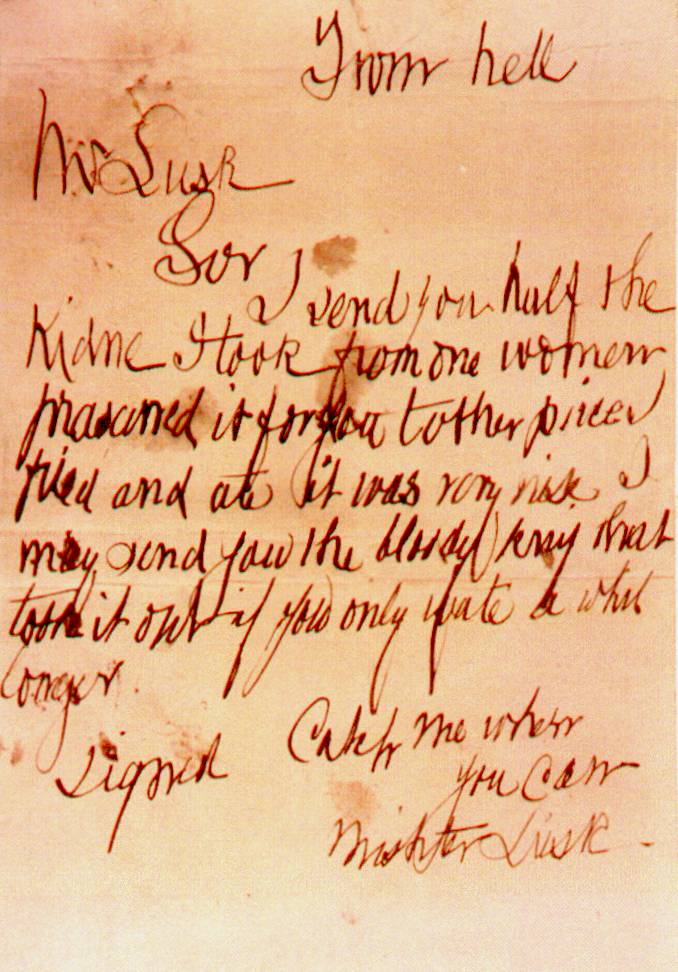
4) All the Ripper letters were genuinely written by the murderer AND Michael Maybrick wrote all the Ripper letters.

Clearly if both these propositions are true then it's an open and shut case, but they're both patent nonsense. The Ripper letters came from all over the country - indeed all over the world - and were written in a variety of hands. Most Ripperologists (Robinson doesn't much like Ripperologists, mostly because of their failure to spot what is so obvious to him) regard few or none of them as genuine. That's not to say that some or many of them may be genuine, but you really have to make a case for each one of them - not take on a blanket assumption. Hundreds were received and Robinson treats them all as being sent by the murderer - even those which don't even make that claim themselves and are merely letters about the murders.
From Hell
The 'From Hell' Letter
The evidence that Maybrick wrote the letters is insulting to the reader. The letters came from all parts of the country and Maybrick, in visiting concert venues, travelled across the country. But for all that, Robinson offers only one example of an occasion when Maybrick was in the right city at about the right time to coincide with a letter's posting. This should be a rich source of evidence. Maybrick's concerts were widely advertised in newspapers. One might expect a clear analysis cross-referencing letters with concert venues, but none is given. Whether Robinson shunned this kind of forensic approach, or pursued it and decided not to include the results, I don't know.

Robinson explains the letters from the USA by pointing out that someone could board a ship in a British port (say Liverpool), post a letter in the on-board mailbox and then leave the ship. The letter itself would travel to the States, be franked there and then would come back on the next boat, apparently sent from abroad. It may well be that this could be done, but there are still a few dots to join up in demonstrating that it was done, that it was done by Michael Maybrick (rather than anyone else who happened to be in Liverpool sometimes) and that the author was the Ripper.

As to the handwriting, well as Robinson points out:

Michael Maybrick himself had many styles of handwriting, and used many different pens - his table was 'littered with quill pens', noted the New Era article.

There's no direct evidence to support the idea of multiple handwriting styles - but it's evidently a well-known characteristic of people who have several pens.

Even if you ignore the nonsense of travelling from one side of the country to the other in a single day, and having multiple handwriting styles, the fundamental problem remains. Like all evidence based on the letters, it's a case of the Texas Sharpshooter Fallacy. With hundreds of letters to choose from, you're bound to be able to find clues suggesting almost anybody.

-

And that's really it for the case against Michael Maybrick. He was a Freemason who looked a bit like one sketch of a possible suspect. The real reason for accusing him is that he's the brother of James Maybrick - who's a much stronger, though still unlikely candidate. The trouble is, James Maybrick has already been 'done'.

Robinson spends the last section of the book looking at the death of James Maybrick and subsequent trial of his widow, Florence, for her husband's murder. His belief is that it was Michael who in fact killed James and then contrived to frame Florence. In comparison with his charge that Michael was the Ripper, Robinson offers better (i.e. some) evidence, but what's new is not good and what's good is not new. The fact that Florence was innocent has been known widely asserted since the time of the trial and has been covered by many. Robinson provides some reasons to believe that Michael was responsible, but it's not close to convincing. And anyway, the book is supposed to be about demonstrating that Michael Maybrick was Jack the Ripper, not that he killed his brother.
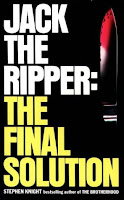
Jack the Ripper - The Final Solution
There are a few positives from the book. Robinson makes a clear case for the incompetence of the Metropolitan Police in investigating the crimes, and conveys it with a evident passion, as he does his description of the inequalities of Victorian London. But this is no substitute for logic and accuracy. He bases most of his Freemasonry theory on work already done by Stephen Knight (in Jack the Ripper - The Final Solution) and others, but then misrepresents Knight's position on many important details, claiming that Knight said:

  • The Duke of Clarence1 was the Ripper. No, Knight said the Ripper murders were done by others to cover up Clarence's morganatic marriage. 
  • Annie Crook, Clarence's supposed wife, was a prostitute. No, Knight says she worked in a sweet shop. (I may be being unfair here. Robinson actually describes Crook as a 'whore' and it's hard to know whether this is meant to be taken literally or is just another of the abusive epithets he scatters through the book.)
  • Martha Tabram was a Ripper victim. No, Knight sticks to the canonical five and regards Tabram as being the victim of a different killer.
  • Catherine Eddowes was one of the women who tried to blackmail the establishment over Clarence. No, Knight claims Eddowes had nothing to do with the blackmail and was killed because she was mistaken for Mary Kelly.

All these may be small errors, but they reflect a sloppy attitude to research. If I can spot all these mistakes in the two paragraphs Robinson writes on a subject with which I am familiar, why should I trust his reporting on other matters with which I am less so?

-

The figure of Clarence and Robinson's habit of flinging abuse at the characters he describes leads on to one of the book's more unsettling, if peripheral aspects. Robinson describes the Duke of Clarence's probable involvement in the Cleveland Street Scandal. Again there's nothing new here - a male brothel on London's Cleveland Street was raided and there was evidence that Clarence had been a client. Homosexuality was illegal at the time, but moreover many of the boys working there were under-age even by today's laws. 

Thus when Robinson describes Clarence as an 'effete little useless pederast' it's possibly true and given the nature of the crime it's difficult to object completely to the level of invective. It's disturbing, however, when his name-calling takes a more generally homophobic turn. Terms such as 'nancy' seem to say more about the writer than the individual described. In discussing Michael Maybrick's motive (that he was gay and therefore - obviously - hated women) Robinson gives us:

I don’t actually know if Maybrick was homosexual, but predicated on that infallible adage, 'If it walks like a duck, etc', he was probably a bit of a ducky.

Aside from the fact that Robinson doesn't 'actually know' very much at all about the case, one can't help feeling that those encounters with Uncle Monty, as told in Withnail and I, left a little bit more of a scar on the memory than we might have imagined.

Uncle Monty
Richard Griffiths as Uncle Monty

Admittedly it's somewhat refreshing to read a book on Jack the Ripper that displays an angry contempt for the failures of Victorian jurisprudence rather than mere historical disinterest, but it should cut both ways. Robinson is at perhaps his most passionate when describing two flagrant miscarriages of justice: Florence Maybrick's conviction for the murder of her husband and the case of William Barrett, tried (though acquitted) for the murder of 8-year-old Johnnie Gill in Bradford in December 1888 (where Robinson can be particularly sure of Barrett's innocence since he knows that the Ripper/Maybrick, in a surprising change of modus operandi, was in fact the killer).

Both Florence Maybrick and William Barrett were almost certainly innocent - there was no more than a hint of a prima facie case against them. Robinson is right to berate those who tried to condemn them.

Perhaps though, in the case of Michael Maybrick where Robinson provides not even that much in the way of evidence, he might consider the plank in his own eye first.


Notes:

1. Prince Albert Victor didn't actually receive the title Duke of Clarence until after the time of the murders, but this is generally how he is referred to.

Monday, 13 April 2015

Come and Visit Your Good Friend Sweeney


Review: Sweeney Todd - English National Opera, London Coliseum.

Sweeney Todd
Dontcha hate it when you're enjoying a show, but the rest of the audience are clearly enjoying it more? Or, more accurately, when the rest of the audience are making it clear that they're enjoying it more? Sweeney Todd at the London Coliseum was a good show, but a standing ovation? What are the audience going to do when they see something really great?

I've seen quite a few Sweeney's in my time, both professional and amateur. The best two were probably the version starring Michael Ball and Imelda Staunton at Chichester in 2011 (later transferred to the Adelphi in London, where I saw it) and The Royal Opera House production of 2003.

Sweeney ToddThe ENO production comes in behind these, but not so very far behind. The most notable feature is that it's 'semi-staged'. This is probably its biggest fault. Sweeney's music and lyrics are among the best of the twentieth century, and stand up easily to concert performance and to recording. On the other hand, the sheer gruesomeness of the razors, the chair, the oven and much more really do lend the story to a full staging. Even the most parsimonious amateur productions try to make some attempt at realism with these aspects.

In being semi-staged, this production fell between the two stools - and worse than that, it opened by deliberately emphasizing the point. Throughout, the entire orchestra is on stage (impressive both visually and aurally) and the show opens with the cast lining up in front of music stands to sing, at which I felt a certain disappointment - but then came the twist. Midway through the opening number, the cast rebel, throw aside their music and stands, kick over some unnecessary set decoration and overturn the unconvincing grand piano to make it into a rostrum as they transform the stage into something more dynamic.

The point seems to be that we don't want this fusty concert staging, we want a full production! I quite agree, but it's a shame that this revolution can only deliver semi-staging. This is Liberal Democrats raging against the Tories, before pusillanimously adding, but let's not go as far as Labour.

That said, some of the staging was very effective. Todd's chair didn't deliver his victims down a chute to the bakehouse; he simply covered their faces with a cloth and let them walk quietly away, which worked fine. I've certainly seen it done worse: an amateur production where victims had to do the 'walking downstairs behind the desk' trick. Ultimately though, the limitations of the staging, particularly in the final scenes, meant that for me the tension did not build quite as well as it usually does.


The big production numbers were generally well choreographed, the best of them being the Act II opener, More Hot Pies, which worked to a climax of Mrs Lovett being lauded by her adoring customers in a style that echoed Marilyn Monroe in Diamonds are a Girl's Best Friend.
More Hot Pies

The on-stage orchestra was used to mixed effect. A plus-point was the interaction with violinists and flautists when Todd and Lovett discuss pies made from fiddle and piccolo players. In some instances, the musicians' equipment was used for props. This worked well when conductor's baton was used as a comb, or when one of the double-bassists' stools was used as Todd's preliminary barber's chair.

But the idea got more strained when musical props were used that did not come from the orchestra. A cymbal was used to represent (geddit?) the dish that pies were served on, but (unless I missed it) this was brought on as a prop, rather than taken from the orchestra. And the kettle drum which Lovett uses as a worktop (geddit? - no, hang on, it's a pie shop, not a tea shop) was twice brought on by stage crew, breaking any real connection with the orchestra. Similarly the trombone used to grind the meat (ged... no, don't even bother) was not taken from a trombonist; it was just an extension of the idea of musical instruments, the concept of why they were there having been forgotten.

By definition though, this was never going to be a production that stands or falls on its staging. Musically, it was pretty top-notch. The orchestra and chorus sounded good, and the supporting cast were generally excellent. Jack North's Tobias managed to avoid the straight-out-of-theatre-school precociousness that such a young role can sometimes deliver. Rosalie Craig's Beggar Woman was too young to make any sense in terms of plot, but a difficult role was excellently sung. 

Emma Thompson and Bryn Terfel
Emma Thompson as Mrs Lovett and Bryn Terfel were both on top form. Terfel's bass brought a strength and sustain to the music that you don't hear in more musical-theatre voices, and his acting was just right in a part that has to be mostly understated, but of occasional devastating passion. Thompson's voice is a contrast in style, and has a clear break in it that I thought would irritate, but which I quickly got used to. She performed the comedy well, but not as well as much of the audience seemed to think.

The jokes in Sweeney Todd I find much like the jokes in Shakespeare: they're witty rather than funny and you've heard them a dozen times before. They need a lot of clever delivery to make them fresh, and while that was often successful, it can't be done on every line. Maybe I do the audience a disservice in assuming they're all familiar with the show, but even heard for the first time, many of the gags just aren't laugh-out-loud funny. And some of the best are impossible to deliver well. For example, Mrs Lovett's 'That's all very well,' after Todd's devastating rendition of Epiphany is impossible to time because of the thirty seconds of applause that follow the song. And yet it got a big laugh - not a reflex, visceral convulsion at the humour, but a demonstration to the rest of the audience that the joke was got. 

It's worth mentioning some of the cuts that were made. The two acts were 85 minutes and 55 minutes, so there was no real tightness on time, which makes me wonder at the reasoning behind some of it. As is often the case, the tooth pulling section of The Contest (don't think Seinfeld) is cut and having seen it both with and without I can't say I feel too strongly either way. 

More unusually though, all the toing and froing over Pirelli's death has gone. Traditionally he's throttled by Todd, but not quite killed, and dumped in a trunk. Then there's various business with both Lovett and Tobias coming up to look for him, while Pirelli's hand waggles, caught in the lid of the trunk, until Todd finally despatches him with the razor. I'm not sure it ever works that well, and probably would do less so in such a big theatre. But what the scene does do is set up the unpleasant ambiguity of Lovett's relationship with Tobias, fulfilled in the second act where her affection for him is revealed as pure sentimentality. As it is, Tobias simply disappears until the beginning of Act II.

The strangest cut, however, is not to include The Tower of Bray in Parlour Songs. While it's never going to be a hit, it's not long and is particularly haunting as a trio with Tobias below in the bakehouse. (This was attempted with Sweet Polly Plunkett, but wasn't contextualized and didn't work so well musically.) Additionally the dialogue around The Tower of Bray provides for some good jokes: 'LOVETT: How many bells are there? BEADLE: Twelve.' - I might even have laughed at that (though I've achieved as much by telling you that I might have).

In the end, it's about expectations. I love Sweeney and I was very slightly disappointed by a production I'd had high hopes for. Impertinent of me though it may be, I suspect some of the standing ovators were overcompensating for similar disappointment. For a seasoned Todd-follower there was plenty to enjoy and, as there always is, a little to criticize too. For a novice, I'd have to recommend full staging - maybe Thompson and Terfel should give it a go.


Monday, 16 March 2015

I Am Not As Other Men

Last year the results of an experiment were published that demonstrated that Americans are irrationally prejudiced against atheists1. Participants were described the life of an evident psychopath who in his youth tortured animals and in later years murdered homeless people. They were then asked if it was more probable that this person grew up to be 1) a teacher, 2) a Christian teacher, 3) a Muslim teacher or 4) an atheist teacher.

The results were that almost half the people surveyed went with an atheist teacher (with lower figures for a Christian teacher and even lower for a Muslim teacher).

The problem is that all those answers are wrong - categorically and unarguably wrong. It must be more probable that the person was a teacher. Given that there are some teachers who are not atheists, it is clearly more likely that the person (that any person) is a teacher of unspecified religion rather than an atheist teacher (or indeed a teacher of any other faith). Even if you hold the strange opinion that all teachers are atheists then options 1) and 4) become equal. It cannot be more probable that the person is an atheist teacher.

It's an example of what is known as the Conjunction Fallacy2, an example of Cognitive Bias3 that occurs in many situations.

In Britain it affects political opinion, as a recent survey reveals.

Now when it comes to economic policy, I reckon I'm a tad to the right of the UK population as a whole - which puts me way to the right of most people I discuss politics with. I should emphasize that this is only with regard to economics - on social policy I'm reliably informed that I have opinions so liberal they make David Cameron feel physically ill4.

That said, I think that I am on the right because of my opinions, not the reverse. I have made no decision that I am right wing and therefore adopted opinions favoured by the right. Indeed, in the past those same opinions have put me slightly to the left of centre.

And as most of us do, I'd always thought that most other people think like me. Not that they come to the same conclusions as me, obviously, but that they base their alignment on their opinions and not vice versa

A YouGov survey conducted last week demonstrates that I was wrong5.

Participants were asked the same question regarding various public services ranging from hospitals to banks. The question was whether the service was best run by the public sector, the private sector or that it doesn't matter as long as standards of service are maintained. 

The answer is no-brainer. It doesn't matter as long as standards are maintained. That's assuming that people actually want good public services, which for the most part I'll take as read. But given that assumption, the answer is just as clear as that the psychopath is more probably a teacher.

Seems I'm in a minority, however. Our survey said:


The immediate conclusion we might draw from these results is that 18% of the population want hospitals run by the private sector, but I see something far more depressing. What we can read from that first line is that 92% of the population do NOT want standards to be maintained in hospitals. Given the choice between standards and observance of political dogma they chose their own flavour of dogma.

Now you might disagree with my interpretation, you might say that what people are saying is that they favour public hospitals because that's the best way to maintain standards. That may be how people are thinking, but if so it's another fine example of the Conjunction Fallacy. Only if you have absolute certainty that your way of doing things is the way that maintains standards do the two options become equivalent. That's a megalomaniacal degree of certainty. And even then, it only makes the two options equal, so the answer should be 'don't know'.

I've tried to think of other explanations. Maybe the participants were just too busy to think about it and defaulted to a dogmatic response? But the problem is that here the pragmatic answer is the easy answer: we want what's best. It's only in the real world that things get difficult, when asking for what's best prompts the difficult follow-up question: and how are we going to achieve that? If people aren't even prepared to think in the easy case, what hope have we in the difficult?

I can't make sense of it, and yet it makes sense of much of my experience of politics. I'd always assumed that people were like me, that even when we disagree on policy our starting point is what is best for the country. But it turns out that that isn't the case - when  asked directly, most people favour dogma.

What's missing from the survey is a more direct, neutral question: Do you favour a) whatever maintains standards or b) an ideological solution. I suspect in that case more would favour option a), but if so it would only tell us that people don't recognize their own opinions as ideological.

There was one further breakdown of the data, however, looking at the tendency to choose the pragmatic option (maintaining standards) broken down by party support:


In all cases but one, Conservatives were more likely to choose the pragmatic option than Labour voters. It's not great news for them - the pragmatists are still a minority - but it still seems to be a significant difference.

Which is odd, since one of the most common accusations thrown by the left is that is that it is the right who are ideologically driven. It seems that if there is a difference, dogmatism is slightly more a feature of the left.

But that's a digression. Being pragmatical doesn't mean that you come up with better policies, but it does at least give you a chance. If you can't even admit that you'd prefer good standards to the implementation of an ideology, what contribution are you really making?

I'll always place myself firmly in that minority cyan block in the middle of the chart. And if, like most people, you don't place yourself there, then what's the prospect of any discussion between us?

UPDATE: For a good general introduction to cognitive biases try this handy guide.


Tuesday, 21 October 2014

What Have the Russians Ever Done for Us?

Igor Stravinsky

Name some great composers of the twentieth century. Chances are a few of them will be Russian: Prokofiev, Rachmaninov, Stravinsky, Shostakovich. For me, the last two are particular favourites.

Dmitry Shostakovich
Igor Stravinsky was twenty-four years older than Dmitry Shostakovich, but perhaps a bigger difference between them was that Stravinsky never lived in the Soviet Union, while Shostakovich spent his entire adult life there. By the time of the Revolution, Stravinsky was already famous and travelling the world. The two composers did not meet until 1962, when the totalitarianism of Stalin had begun to thaw under Khrushchev and the eighty-year-old Stravinsky at last felt it was safe to visit his homeland. A banquet was arranged at the Metropole Hotel in Moscow in honour of Stravinsky, with Shostakovich in attendance. Aram Khachaturian, another great Russian – well, Georgian – composer, witnessed their meeting:

They were placed next to each other and sat in complete silence. I sat opposite them. Finally Shostakovich plucked up the courage and opened the conversation:

‘What do you think of Puccini?’

‘I can’t stand him,’ Stravinsky replied.

‘Oh, and neither can I, neither can I,’ said Shostakovich.1

I find it hard to disagree with them. However entertaining Puccini’s music is, it is only the climax of a West-European and specifically Italian style that had developed over the previous century. The Russian’s were doing something quite new.

Alexander PushkinAnd it wasn’t just in music. Name some great novelists – of any century. You’ll probably start off with quite a list of English or English-speaking writers, but after that it won’t be long before you get to Tolstoy and Dostoyevsky, and not much longer to Bulgakov, Pasternak, Gogol and Nabokov (whom you might already have listed, since he wrote novels in both English and Russian). If you allow the constraints to expand a little you might also include Chekov as a playwright and Pushkin as a poet. And that’s just to list the household names (my household, anyway).

This blossoming of literary talent occurred over the shortest of periods. To go from Pushkin to Tolstoy is almost to go from Chaucer to Shakespeare. From one of the first to use his native language (as opposed, in both cases, to French) to the archetype of writing in that language. It was a transition that took Britain over two centuries, but took Russia scarcely three decades. And Britain has rarely been in the same league as Russia with regards to composers. As for artists, perhaps Britain does better overall, but just as our music has no Stravinsky, our art has no Kandinsky.

First Abstract Watercolour - Vasily Kandinsky, 1910

Like Shostakovich, Vasiliy Vasilievich Kandinsky was in Russia at the time of the Revolution, but was able to leave in 1921. He settled in Germany – until the Nazis closed the Bauhaus, where he taught. He moved to France, soon to find himself once again under Nazi rule when they invaded. He died just four months after Paris was liberated. Long before that, in 1910, he produced a painting which he appropriately titled First Abstract Watercolour. It was just that – the first truly abstract painting. Kandinsky went on to produce many others, and founded an entire art movement.

Kandinsky equated painting with music and tried to imitate music’s inherently abstract nature. He called many of his works compositions and experienced art and music synaesthetically. Early in his career he wrote:

Colour is the keyboard, the eyes are the hammers, the soul is the piano with many strings. The artist is the hand that plays, touching one key or another, to cause vibrations in the soul. 2

Composition VII - Vasily Kandinsky, 1913

Stravinsky and Kandinsky knew each other in Paris in the 1930s, though unlike the artist, the composer left France for America before the German occupation. It was long after the Russian Revolution, and longer still after each man’s personal revolution in his own field of art. The 1910s were a decade that changed the world in many ways. Politically the impact of the First World War and the Russian Revolution cannot be underestimated, and we shouldn’t forget the Xinhai Revolution in China or the Easter Rising in Ireland. The sinking of RMS Titanic is still remembered today and marks the apogee, and therefore the endpoint, of mankind’s blind faith in technology. Kandinsky produced the first abstract painting in 1910, but it was in 1913 that Stravinsky’s revolution became violent.

Le Sacre du Printemps (The Rite of Spring) was first performed at the Théâtre des Champs-Élysées on 29th May 1913. The fact that it caused the audience to riot is well-known, and not entirely overstated. But the production itself was revolutionary, both in terms of its music and its choreography. The première has been described as ‘the most important single moment in the history of twentieth century music’3. The whole of the production team was made up of Russian émigrés: Stravinsky, the composer; Vaslav Nijinsky, the choreographer; Nikolai Rerikh, the set designer; Sergei Diaigilev, the producer. None of them died in the country of his birth. It was in the Russian Empire that their talents first went unrecognized, but in the Soviet Union that they knew they would not be free to express themselves as artists.

Dancers from the première of The Rite of Spring

But art did flourish in the Soviet Union, even under Stalin, though the lifestyle of those who produced it was precarious. The Soviet leader regarded himself as an expert on every aspect of Russian life – military, economic and cultural. In each field he was arbitrary. In 1929 Mihail Bulgakov found himself unable to make a living when the Soviet government banned the publication of his novels and the production of his plays. But at the same time Stalin intervened personally to protect Bulgakov from arrest. And yet when Bulgakov wrote to Stalin, asking for permission to leave the Soviet Union on the grounds that he was not able to practise his profession, the dictator refused. He died in 1940, but it was more than two decades before many of his major works were published. When they were it became clear why they had been regarded as so dangerous – although he was not always critical of the regime.

Joseph Stalin
Music did not convey so obvious a message. As Kandinsky had observed, music is by its nature more abstract than literature – harder to identify with a political opinion. Dmitry Shostakovich’s work was at first found to be favourable by the authorities. His opera, Lady Macbeth of Mtsensk, was initially described as a work that ‘could have been written only by a Soviet composer brought up in the best tradition of Soviet culture.’4 But that was before Stalin had seen the opera. Soon after he did, articles criticizing it began to appear in Pravda, and Shostakovich’s earlier works began to be critically reappraised. The same year, 1936, Shostakovich completed his Fourth Symphony. As with Bulgakov’s works, the symphony wasn’t performed until decades later, in 1961 – but at least the composer was alive to witness it. He was luckier than many around him; this was the era of the Great Purge, when many were arrested and executed, including his brother-in-law.

But Shostakovich was no fool. He changed his compositional style and his Fifth Symphony was a huge success. An official review praised him for ‘not having given in to the seductive temptations of his previous erroneous ways.’5 During World War II he wrote his Seventh Symphony – titled Leningrad. One of its first performances was in the city after which it was named, at the time under siege by the Nazis, the scores smuggled in to be performed by the city’s starving orchestra. It is still regarded as a memorial to the 25 million Soviet citizens who died in the war.

St Isaac's Cathedral, Leningrad, during the siege

But despite his success, Shostakovich was once again denounced in 1948, along with Prokofiev and Khachaturian. With Stalin’s death he gradually came back into favour. In 1960 he joined the Communist Party, but only so that he could become General Secretary of the Composers' Union.

It would be a preposterous exaggeration to claim that all of Russian culture can be compressed into a period of less than two centuries, but from the viewpoint of the West, it can seem like it. From – to choose a couple of arbitrary points – the birth of Aleksandr Pushkin in 1799 to the death of Aleksandr Solzhenitsyn in 2008 one could pick almost any decade and find a great work of art produced by some Russian or other. Most of it was produced by individuals whose lives were oppressed by a totalitarian regime, or who had fled such a regime for the freedom of the West. Russia now is in a strange place politically – more liberal than it has ever been, and yet still authoritarian by the standards of the rest of Europe. In the past it has been the birthplace of revolutions in every field of culture which have swept the world. It’s difficult to see much hope for the prospect of another, but Russia – that riddle, wrapped in a mystery, inside an enigma – can always surprise.

1. E.Wilson, Shostakovich: A Life Remembered
2. Hajo Düchting, Wassily Kandinsky, 1866-1944: A Revolution in Painting
3. Thomas Forrest Kelly, First Nights – Five Musical Premiers
4. Dmitry Shostakovich (compiled by L. Grigoryev and Y. Platek), Shostakovich: About Himself and His Times
5. E.Wilson, Shostakovich: A Life Remembered